Thursday, March 13, 2008

Nocturnal Animals Stamp

Nocturnal Animal StampsAnimals live in virtually every type of habitat available in the Malaysian rainforest and even exploit man-made habitats. One interesting feature in animal ecology and behaviour is that some animals travel and feed mainly by night (nocturnal) as opposed to animals that move about during the day (diurnal). Various birds, mammals and reptiles have evolved towards a nocturnal way of life for numerous reasons. Due to the reduced amount of light at night, strictly nocturnal animals generally have good night vision to allow them to seek out prey and to avoid predators.

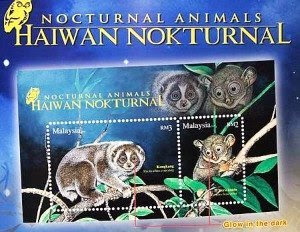
Nocturnal Animals Miniature SheetMoonrat (Echinosorex gymnurus)

Generally solitary, this small mammal is strictly terrestrial and confined to the forest floor, often frequenting areas by the streams and is known to be active by day. It has a very strong body odour in the wild. Earthworms, beetles, spiders and snails are amongst the things it feeds on.

Malay badger (Mydaus javanensis)

The Malay badger is a terrestrial animal and is known for its very strong odour. It sleeps in underground burrows and feeds mainly by digging into the ground for food such as earthworms and insect larvae. Although found in mature forests, it is apparently more frequently seen in secondary forests and open ground such as gardens.

Nocturnal Animals First Day CoverGolden Cat (Catopuma temminckii)

Little is know on the ecology and life history of this medium sized cat. Its coat of golden colour is largely unmarked and adults can weigh as much as 12 kilogrammes. Although terrestrial, it can apparently climb trees when necessary. Its prey includes mousedeer, birds, lizards and other small animals.

Nocturnal Animals First Day CoverFlying Fox (Pteropus vampyrus)

This is the largest bat in Malaysia bat in Malaysia and a full-grown adult can weigh more than a kilogramme. Large roosting colonies of this bat are often found in mangroves or nipah palm. This bat is known to fly long distances to feed on flowering or fruit trees and it is an important pollinator of many forest trees including durians.

Slow loris (Nycticebus coucang)

Largely arboreal, this primate which can weigh almost a kilogramme, is often found alone although couples with dependent young are sometimes seen. It feeds on small animals, mostly insects and on pulpy fruits. It lives in mature and secondary forests as well as in gardens and plantations.

Nocturnal Animals Presentation PackTarsier (Tarsius bancanus)

This small primate of less than two kilogrammes is active from ground level to al least seven metres and generally leaps from tree to tree. It feeds mainly on large insects and is often solitary. Tarsier is known to make high pitch calls frequently and can be found in both mature and secondary forests.


Nocturnal Animals FolderTechnical Details

Date of Issue : 13-Mar-2008

Stamp Value : 30 Sen (2 Designs); 50 Sen; RM 1

Sheet Content : 20 Stamps

Perforation : 14

Miniature Sheet Size : 120mm x 70mm

Paper : SPM Watermarked, Phosphor Coated

Printing Process : Lithography / Glow In The Dark

Printer : Percetakan Keselamatan Sdn Bhd

Stamp Designer : Hazel Design

First Day Cover Value : 30 Sen

Presentation Pack Value : RM 4.00

Miniature Sheet Value : RM 5 (RM3; RM2)

Folder Value : RM 5.50


The Start Online 15 March 2008, Tuesday Press Release

FOR the first time, Pos Malaysia has come up with special glow-in-the-dark stamps featuring unique nocturnal animals.

Much to the delight of many a philatelic collector, these stamps come in a miniature sheet measuring 120mm by 70mm and feature the slow loris/kongkang (RM3) and the tarsier/kera hantu (RM2).

Four other stamps, measuring 50mm x 30mm, will also be sold and they feature the tikus ambang bulan (moonrat) (30 sen), teludu (Malay badger) (30 sen), kucing tulap (golden cat) (50 sen) and keluang (flying fox)/ (RM1).

“Pos Malaysia has been dedicated in helping to enhance the public's knowledge about nature. These stamps were printed in two stages. One to print the actual stamp and the second time to layer on the coat of special glow-in-the-dark ink,” said PosNiaga Philately senior manager Wong Lai Kim.

Wong added there would be no more printing of the glow-in-the-dark stamps this year.


Nocturnal Animal
Corporate communications department senior assistant manager Maisara Noor Ahmad said Pos Malaysia was always looking for something different and unusual to feature on its stamps.

“The stamps are also a tool to create awareness among the people about nocturnal animals,” she said.

She added however that “that there would be many more interesting and one-of-a-kind stamps” from Pos Malaysia in the coming months.


>>> Read more about "Nocturnal Animals Stamps" <<<

Thursday, February 28, 2008

Bridges of Malaysia Stamp

Bridges Of Malaysia StampsBridges are an important element in establishing communication links between towns and cities that are separated by difficult terrain or rivers. The role of bridges has been important in the economic and social development of Malaysia enabling transportation links in moving people and goods.

The building or bridges over the centuries has evolved from simple wooden structures to sophisticated steel and concrete bridges. Among the most advanced engineered bridge bridge during its time was the Victoria Bridge, Perak built in 1897.

This series showcase these innovative bridges up to the time of Malaysia's Independence in 1957. This collection of historical structures that have played a major role in the growth of industries like tin mining, rubber and the overall economy of the nation are given due recognition.

Bridges Of Malaysia First Day CoverMerdeka Bridge, Kedah

The Merdeka Bridge, built in 1955, was officially launched in 1957, the year Malaya achieved independence. Spanning the Sungei Muda, the longest river in Kedah, the bridge serves a major link for transportation of goods and people. The river also marks the border between Penang and Kedah. Sungei Muda also provides water for consumption and irrigation of rice fields to Penang's province of Seberang Perai. This concrete truss girder bridge was designed and built by the Malaysian Public Works Department.

Victoria Bridge, Perak

The oldest railway bridge in Malaya is the Victoria Bridge in Karai, Perak. Built in 1897, it was the most advanced bridge in terms of its engineering in the Far East at that time. This bridge provides a communication link for the growth of the tin mining industry and the development of the mining towns in the Malayan Peninsula. With the opening of this bridge, the whole of the west coast from Perai to Johor Bahru was linked by rail.

Bridges Of Malaysia StampsSheetKota Bridge, Klang

The city of Klang is divided by the Klang River and was linked by the Brickfield Bridge in 1907. It was destroyed in 1941 during World War II, resulting in great difficulty in transportation and communication, especially for goods transported from Klang Port to other cities. In 1958 a double decker bridge was constructed, the first such bridge in Malaya, with a pedestrian walkway at the lower half. This double decker truss girder bridge was named the Kota Bridge.

Sungei Segamat Bridge, Johor

This bridge was built in 1933 to provide means of transportation to the Segamat district as an initiative by the government to develop the district for its agricultural adtivities and to boost its economy. The Sungei Segamat Bridge is a Steel Pratt Girder Type bridge with a length of 00.43 metres. It provides a railway crossing over the Segamat River.


Bridges Of Malaysia FolderTechnical Details

Date of Issue : 28-Feb-2008

Stamp Value : 30 Sen; 50 Sen (2 Designs); RM 1

Stamp Size : 50mm x 30mm

Sheet Content : 20 Stamps

Perforation : 14

Paper : SPM Watermarked, Phosphor Coated

Printing Process : Lithigraphy

Printer : Percetakan Keselamatan Nasional Sdn Bhd

Stamp Designer : Reign Associates

First Day Cover Value : 30 Sen

Folder Value : RM 5.50


POS Malaysia 26 February 2008, Tuesday Press Release

BRIDGES OF MALAYSIA TO BE THE SPECIAL FEATURE IN THE FIRST SERIES OF 2008 STAMPS

Pos Malaysia Berhad will issue a special collection of stamps and First Day Cover that features the historical bridges of Malaysia. The special stamp collection will be issued on 28 February 2008 (Thursday).

Bridges are an important element in establishing communication links between towns and cities that are separated by difficult terrains or rivers. The role of bridges has been important in the economic and social development of Malaysia enabling transportation links in moving people and goods.

The building of bridges over the centuries has evolved from simple wooden structures to sophisticated steel and concrete bridges. Among the most advanced engineered bridge during its time was the Victoria Bridge, at Karai built in 1897.

“Pos Malaysia is proud to feature these historical bridges in our first stamp series for this year. Bridges play an important function in connecting people and places and significantly, it also acts as the connector towards the development of a society and civilization. As these bridges physically connect people across waterways and terrains, Pos Malaysia Berhad also plays the similar role of bridging together people and businesses through the postal service.,” said YBhg Dato’ Idrose Mohamed, Managing Director / Group Chief Executive Officer of Pos Malaysia Berhad.

“This is the first time Pos Malaysia Berhad produced a series of stamps featuring bridges and we believe that it would be a valuable addition for our customer’s stamp collection. We hope that stamp collectors will take the opportunity to purchase the stamps and First Day Cover as a way to express their sense of pride of the nation’s history as well as to be kept as a token of remembrance to be shared with the future generation,” Dato’ Idrose added.

This series showcase these innovative bridges. This collection of historical structures that have played a major role in the growth of industries like tin mining, rubber and the overall economy of the nation are given due recognition.

Four historical bridges in Malaysia are featured in the stamp designs. The stamps, 50mm X 30mm in size is printed in sheets of 20 on SPM watermark, phosphor coated paper and are available in 30sen, 2 designs for 50sen and RM1.00 denomination :

30sen : Merdeka Bridge, Butterworth – Kedah
The Merdeka Bridge, built in 1955, was officially launched in 1957, the year Malaya achieved independence. Spanning the Sungai Muda, the longest river in Kedah, the bridge serves as a major link for transportation of goods and people. The river also marks the border between Penang and Kedah. Sungai Muda also provides water for consumption and irrigation of rice fields to Penang’s province of Seberang Perai. This concrete truss girder bridge was designed and built by the Malaysian Public Works Department.

50sen : Victoria Bridge in Karai, Perak
The oldest railway bridge in Malaya is the Victoria Bridge in Karai, Perak. Built in 1897 by the Perak State Railway, it was the most advanced bridge in terms of its engineering in the Far East at that time. This bridge provided a communication link for the growth of the tin mining industry and the development of the mining towns in the Malayan Peninsular. With the opening of this bridge, the whole of the west coast from Perai to Johor Bahru was linked by rail.

50sen : Kota Bridge, Klang, Selangor
The city of Klang is divided by the Klang River and was linked by the Brickfield Bridge built in 1907. It was destroyed in 1941 during World War II, resulting in great difficulty in transportation and communication, especially for goods transported from Klang Port to other cities. In 1958 a double decker bridge was constructed, the first such bridge in Malaya, with a pedestrian walkway at the lower half. This double decker truss girder bridge was named the Kota Bridge (Jambatan Kota).

RM1.00 : Sungai Segamat Bridge, Johor
This bridge was build in 1933, to provide means of transportation to the Segamat district as an initiative by the government to develop the district for its agricultural activities and to boost its economy. The Sungai Segamat Bridge is a Steel Pratt Girder Bridge type with the length of 99.43 metres. It provides railway crossing over the Segamat River.

First Day Cover at 30sen each can be purchased at all post offices nationwide. Folders at RM5.50 each is only available at selected post offices.


The Start Online 26 February 2008, Tuesday Press Release

KUALA LUMPUR: Historical bridges will be the theme of Pos Malaysia's first batch of special collector stamps this year, to be issued on Thursday at all Post Malaysia offices nationwide.

The stamps, measuring 50x30mm, feature the Merdeka Bridge in Kedah (30 sen), Victoria Bridge in Perak (50 sen), Kota Bridge in Selangor (50 sen) and Sungai Segamat Bridge in Johor (RM1).

The first-day cover will be available for 30 sen and comes with a pamphlet with a short history of each bridge. The set, complete with four designs, will cost RM2.60.

The stamps are printed on SPM watermarked phosphor-coated paper and can also be bought in sheet form containing 20 pieces of a single design.

There will also be a folder, limited to 1,000 copies, to be sold for RM5.50 each at selected post offices.

"Bridges play a significant role in connecting people and places. It is also the connector towards the development of society and civilisation," Pos Malaysia Bhd managing director and group chief executive officer Datuk Idrose Mohamed said in a statement.

The bridges chosen were built before the country's independence except for the Kota Bridge that was destroyed in 1941 during World War II but rebuilt in 1958.


>>> Read more about "Bridges of Malaysia Stamps" <<<

Monday, December 31, 2007

Garden Flowers Stamp

Garden Flowers First Day CoverGarden Flowers

Malaysia is a paradise of fascinating sights and attractions, well-known for its rich and enormous variety of flora which range from many thousands of species from all over Peninsular Malaysia and the states of Sabah and Sarawak. It is estimated that over 15,000 flowering plant species are found in Malaysia. The flowering plants include some 2,000 type of trees, including 200 different palms and 3,000 species of orchids. In addition to that, the world's largest flower, 'the giant rafflesia' (also known as a corpse lily), as well as the largest pitcher plant, 'the Nepenthes rajah', which can hold up to 2 liters of water, also grow here. The plants come in a tremendous diversity in plant species varying in color, shape, texture and density of leaves.

Sacred Lotus (Nelumbium nelumbo)

Sacred Lotus is an aquatic perennial, originally from Indonesian and India. The Sacred Lotus (Nelumbium nelumbo) has great significance in Eastern religion. This flower is especially sacred to Buddhist to whom it represents the perpetual cycles or reincarnation. It grows up to a height of 19 feet depending on the depth of a swamp or creek it grows in. The roots of the sacred lotus are firmly planted in the mud beneath the water surface. It has a long stem to which the leaves and flowers are attached. The big circular leaves float on the surface and the flowers grow above it. The pink or white sacred lotus blooms early in the morning and the petals will wilt the later hours of daylight. The fruit is a conical shaped pod with the seeds arranged in the holes. When the seeds are ripe, they are released when the pod bends down towards the water. The flowers, seeds, young leaves and rhizomes are edible, while the big mature leaves, 2 feet in diameter, are used to wrap steamed food.

Hydrangea macrophylla

Hydrangea macrophylla is native to Japan and Korea. This shrub can be naturalized in compatible climates. It is a deciduous shrub, growing 1-3 meters tall. The leaves grow opposite each other, in simple ovoid-acute size, 7-20 cm long, with a coarsely toothed margin. Its flowers are pink, white, or blue, depending on soul pH. In acidic soil, the flowers will be blue, whereas in alkaline soil, the flowers will be pink. In neutral soil flowers will be purple. Hydrangea macrophylla has been cultivated for many years as an ornamental plant in Japan, and in the last 150 years, it is also extensively bred in other areas of the world with a temperate climate.

In warm climates, Hydrangea macrophhylla is good for adding a splash of spring time color to shady areas and woodland gardens. Minimal pruning is recommended for most prolific flowering. Flowers are easily air dried and are long lasting.

Hippeastrum reticulatum

Hippeastrum reticulatum is a bulb-bearing herb from southern Brazil. This plant has a fleshy and straight stalk with three or more flowers. Grown from bulbs, the flowers are trumpet shaped, and pink in color with white veins. The flower naturally reaches a diameter of about 3 inches. Typical broad strap-shaped leaves are dark green with clear white stripe down the center. The gorgeous flowers are pink with darker reticulations. It does not have a dormant period. This selection is a slow grower and is not as large as other clones. This flower is normally grown to be used in flower arrangements and as potted plants.

Bougainvillea

This woody climbers were introduced from South America. The long vine are thorny and the alternate ovate elliptical leaves are hairy. The small flowers are surrounded by large papery bracts. An evergreen shrubbery vine, Bougainvillea is popular for its long-lasting, colorful flower bracts which appear periodically throughout the year. Most common colors of the bracts are magenta, purple, white, orange and crimson, though 'rainbow' bougainvilleas with flowers of two colors on the same plant are common today. Bougainvillea can grow on its own as a sprawling shrub, or allowed to grow naturally where it will quickly cover fences or climb onto trees.

Ipomoea indica

Ipomoea indica is a tender perennial with heart-shaped leaves and with flowers produced daily from a dense clustered inflorescence. It grows up to 7 cm long, tubular and arranged in clusters of 3 to 12 flowers. Ipomoea indica is a native of Hawaii and the New World tropics, but it has become an invasive species in Australia. It is also present in Asia, although they grow in subtropical and temperate regions.

Morning glory is a common name for a number of species of flowering plants in the family of Vonvolvulaceae. The Morning Glory flowers often show marks where the corolla was neatly folded or rolled up in the bud. The flowers will start to fade 2 hours before the petals start to curl in. Morning glory is one of the best flowers to decorate fences and walls. Today, Ipomoea indica is found throughout the tropics, scrambling over fences and over woody plants, often to their detriment. However, it is delight when in bloom.

Hibiscus rosa-sinensis

Hibiscus rosa-sinensis is the state flower of Hawaii, and also the national flower of Malaysia. Also known as the Chinese hibiscus, it is probably the most popular and widely planted shrub of the tropics. It is believed to be native to China and came to the world bay via South Pacific and Hawaii. This plant creates a bold effect with its medium textured, glossy and dark green leaves and vibrantly colored, four to eight-inch-wide, showy flowers, produced throughout the year. Cultivars are available with the combination of single or double flowers in shades of white, pink. red, yellow, peach, or orange, or combination of all these. Hibiscus flowers are basically characterized as single or double forms of variations in the number and arrangement of petals.

Flowers are produced continuously in great abundance, making up for the fact that each flower will last only for one or two days with the blossoms opening early in the morning and wilting by late afternoon. Most hibiscuses are odorless, but some of the basic varieties have a light scent. The Hibiscus, Malaysia's nation flower is the pride of the country which signifies the country's strength, unity and independence.


Wilayah Persekutuan Garden Flower Stamps

Johor Garden Flowers Stamps

Kedah Garden Flowers Stamps

Kelantan Garden Flowers Stamps

Melaka Garden Flowers Stamps

Negeri Sembilan Garden Flowers Stamps

Pahang Garden Flowers Stamps

Perak Garden Flowers Stamps

Perlis Garden Flowers Stamps

Pulau Pinang Garden Flowers Stamps

Sabah Garden Flowers Stamps

Sarawak Garden Flowers Stamps

Selangor Garden Flowers Stamps

Terengganu Garden Flowers Stamps


Garden Flowers FolderTechnical Details

Date of Issue : 31-Dec-2007

Denomination : 5 Sen; 10 Sen; 20 Sen; 30 Sen, 40 Sen, 50 Sen (for all 14 States)

Sheet Content : 20 Stamps

Stamp Size : 27mm x 32mm

Paper : SPM Watermarked, Phosphor Coated

Printing Process : Lithigraphy

Printer : Percetakan Keselamatan Nasional Sdn Bhd

Stamp Designer : Prof. Dato' Raja Zahabuddin Raja Yaacob

First Day Cover Value : 30 Sen

Folder Value : RM 5.00

Thursday, December 13, 2007

The FEI 5 Star KL Grand Prix 2007 Stamp

KL Grand Prix StampsThe FEI 5 Star KL Grand Prix 2007

First conceptualized in 1998 to bring the very first top international equestrian event to Asia, the FEI 5 Star KL Grand Prix made its debut as an annual event in 2003 at Putra Stadium, Bukit Jalil, Kuala Lumpur, Malaysia. The only five-star international show jumping event in the Asia-Pacific region, the KL Grand Prix has carved an important milestone in the history of world equestrian sports. 5 Star is the highest possible rating for an equestrian event.

KL Grand Prix First Day CoverThe KL Grand Prix brings together each year the world's top-ranked riders including Olympic gold medalists, World Cup Champions and World Champions and their prized horses to Kuala Lumpur where they vie for the coveted title and one of the world's richest purses. The 2007 event will see the introduction of the FEI Nations Cup, the world's oldest and most prestigious team event where teams from Asian countries will be fighting tooth and nail for honor for their countries. The Pony Club Mounted Games Challenge is also making its first appearance at the KL Grand Prix. Visitors will enjoy watching the skills, dexterity and bravado of the Pony Clubbers scoring points for their teams.

Spectacular horse acts, riveting performances, Malaysia's top artistes and carnival fun and games are organized each year for visitors to enjoy.

Horse Breeds

There are perhaps as many as 160 breeds and types of horses throughout the world today, each with different abilities, characteristics and temperament. The horses depicted in the three stamps here are Warmbloods, which have gained enormous popularity in the past years as sport horses. More and more of these horses are used in competition especially in Grand Prix and Olympic level competitions. There are several types of Warmbloods and each offer its own bit of edge in competition. Visitors to the FEI 5 Star KL Grand Prix can expect to see several Warmbloods in thrilling action jumping over obstacles of up to 1.6 meters.

Hanoverian

The Hanoverian is probably the most successful and one of the oldest of the Warmbloods and today it is one of the most prominent riding horses in the world. It has a worldwide reputation as a show jumper. Many Hanoverians have won gold medals at competitions including the Olympic Games. This breed was founded in 1735 in Celle Stud in Germany by King George II of England who wanted a coach horse that could also be used for agriculture. Through the years with the changes of the function of the Hanoverian, the breed has been further refined with Thoroughbred infusion to make it lighter and more agile. Together with its wonderful temperament and powerful body, the Hanoverian has an added edge in competition.

The Hanoverian's height varies from 15.3 - 17.2 hands (horses are measured in hands which is approximately 4 inches). This breed has no predominant color and solid colors like chestnut, bay, brown, black and grey are common.

Oldenburger

Another breed originating from Germany, the Oldenburg is the heaviest of the German Warmbloods and the most powerfully built of all Warmbloods. Big, powerful and impressive, the Oldenburg is most popular in show jumping and dressage as it is reliable in temperament and has regular paces.

Established in the 1600s initially as a carriage horse, the breed was later developed into an all-purpose riding horse and now it is bred specifically as a sport horse. However this breed still retains its ability as a powerful harness horse. The Oldenburg is known for its athletic ability, calm temperament and strength.

Standing between 16.1 and 17.2 hands in height, the Oldenburg is mostly found in brown, black and bay.

KL Grand Prix SheetDutch Warmblood

The Dutch Warmblood is the product of Holland's two indigenous breeds - the Gelderlander and the heavier Groningen. The breed is a proven performer in the show jumping ring and the dressage arena. A notable show jumper is the millionaire horse Milton known for its famous leap in the air that has brought crowds to a standing ovation. Milton and his illustrious partner, British Olympian John Whitaker have shared many victories in international events. John Whitaker is one of the riders competing at the 2007 FEI 5 Star Grand Prix from 23-25 November.

A fairly modern breed, the Dutch Warmblood was developed in the 1960s to combine the best characteristics of both the native breeds and was further refined with the introduction of Thoroughbred blood. This resulted in an athletic horse with much improved scope and stamina. Reliable and intelligent, the Dutch Warmblood makes a good competition horse. As with all Warmbloods, the Dutch Warmblood continues to evolve and the breeding goes through a very strict selection process to ensure good conformation, action and temperament.


KL Grand Prix FolderTechnical Details

Date of Issue : 13-Dec-2007

Denomination : 30 sen; 50 Sen (2 Designs)

Sheet Content : 20 Stamps

Paper : SPM Watermarked, Phosphor Coated

Printing Process : Lithography

Printer : Percetakan Keselamatan Nasional Sdn. Bhd Stamp

Designer : La Scheers Co. Sdn. Bhd

First Day Cover Value : 30 Sen

Folder Value : RM 5.00

Monday, November 26, 2007

Rare Vegetables Stamp

Rare Vegetables

A wide range of rare vegetables species can be found in Malaysia. It has been estimated that about 120 species of rare vegetables or ulam that are being planted in the home gardens or still growing wild. Some of the rare vegetables are known as ulam based on the way it is being consumed such as pegaga, ulam raja or beluntas. Rare vegetables are categorized as ulam when the fresh or boiled shoots or young fruits are eaten with sambal or budu. Ulam is the favorite appetizer in Malay cuisine. Other rare vegetables are fried or cooked with coconut milk, or made into rojak or other dishes.

Rare vegetables such as terung asam (Solanum ferox), bitter melon (Monordica charantia), torch ginger (Etlingera elatior), petola bantal (Luffa aegyptiaca), winged bean (Psophocarpus tetragonolobus), turi (Sesbania grandiflora), terung pipit (Solanum torvum), kaduk (piper sarmentosum), sword bean (Canavalia gladiata), water celery (Oenanthe javanica), African eggplant (Solanum macrocarpon), belimbing buluh (Averrhoa bilimbi) and rebung buluh betung (Dendrocalamus asper) contain high nutritional value such as carbohydrates, protein, fat, minerals and vitamins. Besides that, many rare vegetables have medicinal values to reduce high blood pressure or control diabetes.

Terung Asam (Solanum ferox)

The tree is small, reaching a height of 0.5 - 1.0 meter tall. The whole plant parts are covered with fine hair. Leaves are sub-opposite in arrangement and the shape is oval with triangular lobes. The upper leaf surface is covered with thorns along the veins. The flowers sprout in racemes with short stalks. Flower petals are white and powdery. The fruits are oval in shape, 2-3 cm wide and also covered with fine hair. The fruit is initially green and turns yellow when it is ripe. its sour taste makes it suitable to be used as a sour flavoring for dishes.

Peria Katak / Bitter Melon (Momordica charantia)

The herbaceous, tendril-bearing vine grows to 5 meters tall. Leaves 4-12 cm wide, with 3-7 deep lobes are alternately arranged. The flowers are yellow in color. The fruit is green, oblong, 17-23 cm long, with a distinct warty surface. Young fruits possess white seeds and piths turning red upon ripening. Fruits taste bitter but the bitter taste can be reduced by soaking the fruits in salt water before cooking. The flesh is juicy and crunchy in texture. The young fruit is normally eaten as ulam. Bitter melons have been used in various Asian medicines for a long time as it is believed to possess anti-malarial properties and can control diabetes and cure skin diseases.

Kantan / Torch Ginger (Etlingera elatior)

The plant can reach 5 meters in height. The flower is pink in color on a long stalk, about 90 cm in length, arising from its rhizome in the ground. Torch ginger flower, also known as Kantan flower is popular because it is widely used as flavoring in many dishes especially in laksa and asam pedas. In addition to that, the flower has high antioxidant properties. The fruit and leaf also posses their unique medicinal values.

Petola Bantal (Nuffa aegyptiaca)

Petola bantal is also commonly known as smooth petola due to the surface of the fruit which is smooth and slightly waxy. The plant is a climber using its tendrils. The fruit is cylindrical is shape, light green with 9-10 dark green lines along the length of the fruit. The flowers are bright yellow and the whole plant is covered with fine hair. Young fruits are normally cooked as vegetables. However, fibers from the matured fruits are used as a sponge for cleaning cooking utensils or as a loofah.

Wing Bean (Psophocarpus tetragonolobus)

Winged bean is also known as kacang kelisa. The plant is a type of vine growing with a climbing twining stem. Leaves are trifoliate with three leaflets. Flowers are beautiful with bluish purple in color. Clusters consist of 2-10 flowers. Winged bean is easily recognized because it has a unique bean pod. The bean pod is about 15-22 cm long, four-angled with frilly edges running lengthwise. The surface is waxy and the flesh of the young pod is partially translucent. The bean pod has a high nutritional content. protein content is also high about 29-39%.

Turi (Sesbania grandiflora)

Turi or geti is a perennial plant reaching a height of 4 meters tall. Leaves are pinnately compound with leaflets in opposite arrangement. Flowers are white or red in color, drooping from the flower stalks. The boiled shoot is eaten as ulam while the young leaves can be cooked with coconut milk. Petals of young flower buds can also be eaten as ulam or cooked as vegetables. In addition to that, the bark, leaf, root and flower of the plant also possess medicinal values.

Terung Pipit (Solanum torvum)

Terung pipit is also known as terung rembang. The plant is weedy and can easily be found at grass fields, bushes or along roadsides. The plant is a shrub reaching a height of 1-2 meters tall. The leaf is large, oval in shape with triangular-lobed margin. The whole plant is covered with sharp thorns such as on the stem, leaf stalks and inflorescence axis. Flowers are white in color and arranged in a cluster. The fruits are similar to berries, round, small in size and are borne in a short bunch. The young fruits are usually eaten as ulam either fresh or boiled. It can also be fried or cooked in dishes. The fruits are believed to reduce high blood pressure.


Technical Details

Date of Issue : 26-Nov-2007

Denomination : 50 Sen (3 Designs)

Stamp Size : 29mm x 34mm

Miniature Sheet Denomination : RM1.00 x 4

Miniature Sheet Size : 120mm x 70mm

Stamp Size in Miniature Sheet : 29mm x 34mm

Perforation : 14

Sheet Content : 20

Paper : SPM Watermarked Phospor Coated

Printing Process : Lithography

Printer : Percetakan Keselamatan Nasional Sdn BhdStamp

Designer : Hazel Design

First Day Cover Value : 30 Sen

Folder Value : RM 5.00

Tuesday, September 25, 2007

State Emblems of Malaysia Stamp

State Emblems StampState Emblems of Malaysia

The National and State Emblem is a symbol of pride to the people of a state or nation. Each symbol in the emblem has its own specific meaning.

Emblem of Malaysia

The National Emblem (Coat of Arms) of Malaysia consists of a shield guarded by two tigers that are traditional Malay symbols signifying strength and courage. On the top of the shield is a yellow crescent with a 14-pointed star. The yellow color of the crescent and the star symbolizes the country's monarchy. The crescent also represents Islam as the official religion while the star represents the thirteen states and the federal territories of Malaysia.

Five keris are located within the upper rectangle. The keris represent the former Unfederated Malay States, namely Johor, Terengganu, Kelantan, Kedah and Perlis. Below the keris are rectangles colored in red, black, white and yellow that symbolizes the Federated Malay States. Red and yellow are for Selangor, black and white for Pahang, black, white and yellow for Perak and red, black and yellow for Negeri Sembilan.

The rest are insignias of four remaining states. The palm tree along with the bridge represents Pulau Pinang, while the 'Melaka' tree on the opposite end of the shield identifies Malacca. The lowest portions is represented by Sabah's Coat Of Arms on the left and Sarawak's Coat Of Arms on the right. The Hibiscus flower in the center is the national flower of Malaysia. The tigers featured as holding the previously known Federated States of Malaya's Coat of Arms is used in the National Emblem. The motto, 'Unity is Strength' (Bersekutu Bertambah Mutu), written in both Romanized Malay and Jawi is located in the yellow-colored scroll below the shield.

State Emblems First Day CoverState Emblems

Kedah. The wreath of paddy symbolizes agriculture, the State's principle commodity. The red background color is the traditional color of the State, signifying prosperity. The crescent symbol signifies Islam while the shield symbolizes the role of the Sultan as the protector and guardian of his subjects.

Negeri Sembilan. The nine stalks of rice on the shield represents the nine states in the federation of the Old Negeri Sembilan. The red color in the shield reflects the past British connection. The black color denotes the Datuk-Datuk Undang Yang Empat and Tunku Besar Tampin, whereas the yellow color signify the Yang di-Pertuan Besar. The sword and its sheath above the shield represent justice, whereas the "Changgai Puteri" between the sword and its sheath represent the sovereignty of the Ruler.

Pahang. The spear head that incorporates the design of the coffee leaf, with the word "Negeri Pahang" was originally gold in color including the staff and guard. The reason for the choice is that in 1862, gold is the number one produce in the state of Pahang. Also in the old days, it was said that nothing can stand against weapons or weapon heads made of gold. The pair of elephant tusks criss-crossed against each other in front of the spear/coffee leaf signifies the abundant existence of elephants in the state. The inclusion of "Ya La Tif" implies that the state will be ruled and governed in soft and subtle ways that will be a blessing to all its citizens.

State Emblems SheetKelantan. The crown stands for the sovereignty of the State while the two spears and two keris signifies the power of the Kelantan Malays. The symbol of the star and crescent signify Islam. The two cannons signify that the State is always ready to defend itself. The two deers serve as reminders of the period in the State's history when Che Siti Wan Kembang, the Queen of Kelantan (at the end of 14th century), ordered the State's gold coins to be stamped with the image of these deers for which she held such deep affection. The State motton reads "In God, the Government of Kelantan Submit".

Johor. The crown denotes the Ruler. The four stars at the corners of the white shield stands for the four original districts of the State, namely Johor Bahru, Muar, Batu Pahat and Endau, while the star and crescent signify Islam. The two tigers recalled the period when wild beasts roamed the State. The floral decorations below the shield represent gambier and black pepper, the two main produce of the State. The State motto reads "In The Hands of Allah".

Perak. This crest which is worn by the Ruler on his headdress symbolizes his sovereignty. The crescent signifies Islam as the official religion, whereas the paddy flower stands for the primary occupation and main produce of the people and the state.

Perlis. The wreath of paddy represents the primary occupation and main product of the State. The shield represents the pride and symbol of honor of the State as a rice granary.

Selangor. The crescent and the star signifies Islam, that is the State's official religion. The red spear in the center with a short keris to the right and a long keris to the left are part of the State regalia. The Jawi writing reads the State motto, 'Under the protection of Allah'. Below the phrase appears the broad belt (tali bengkung) or sash worn at the waist by warriors in the past.

Terengganu. Crescent and star symbolizes Terengganu as an Islamic state. The crown symbolizes the sovereignty of the King and the sword, mace and the long keris signifies the state's royal regalia. The Quran is placed on the right to represent Islam as the official religion, whilst The Book of Law placed on the left signifies justice. The Wali or Selampai is to denote part of the state's cultural regalia.

Sarawak. The Bunga Raya (Hibiscus) that is the national flower of Malaysia, is positioned on the right and left side of the Kenyalang bird. The banner underneath the Keyalang bird's feet carries the new State motto: "Bersatu, Berusaha, Berbakti" (Unity, Industrious, Dedicated). On the bird's chest is a shield bearing the state colors namely black, red and yellow.

Pulau Pinang. The areca tree (pokok pinang) gave the island its name. The Penang Bridge is not only a source of pride to the people of Pulau Pinang; it also unites the island with mainland part of the State, as well as symbolizing the unity between the state and the federation. The two pillars of the bridge stands for two basic features of the New Economic Policy, namely the eradication of poverty and restructuring of society, while the four cables represent the four major races in the nation, that is the Malays, Chinese, Indian and others. The five blue and white waves symbolize the five principles of the Rukun Negara (National Principles) and the five administrative districts of the State.

Sabah. The two arms symbolize unity and cooperation among the State's multi-racial community for progress and success of the country. The five colors represent the five divisions in the State. Zircon blue symbolizes peace and tranquility, white - purity and justice, chili red - courage and conviction, light blue - unity and prosperity and royal blue denotes strength and cooperation. The silhouette shape of Mount Kinabalu is a symbol of the State of Sabah. The State motto reads "Successful Sabah" on the red scroll.

Melaka. The various colors are the colors of the Federated States of Malaysia and indicates that the Malacca is part of the Federated States. The five keris represents five warriors who are well known for their bravery in ancient Malacca: Hang Tuah, Hang Jebat, Hang Lekiu, Hang Lekir and Hang Kasturi. The crescent moon and star in the middle of the top section are the symbols of Islam, the official religion of the State. The Melaka tree, placed in the center is the tree from which the State derived its name. The two mousedeers supporting the shield serve to recall the incident involving the mousedeer, which led the first ruler of Malacca to choose the site and formed his empire. The state motto on the blue scroll reads "Unity is Strength".


State Emblems FolderTechnical Details

Date of Issue : 25-Sep-2007

Denomination : 50 Sen (2 Strips of 7 designs)

Stamp Size : 25mm x 30mm

Perforation : 14

Sheet Content : 28 Stamps

Paper : SPM Watermarked, Phosphor CoatedPrinting

Process : Lithography

Printer : Percetakan Keselamatan Nasional Sdn Bhd

Stamp Designer : Pro. Dato' Raja Zahabuddin Raja Yaacob

First Day Cover Value : 30 Sen

Folder Value : RM 5.00

Alltop, all the top stories
BlogMalaysia.com
All Malaysian Bloggers Project