Saturday, May 14, 2005

Birds Of Malaysia Stamp

Birds Of Malaysia Stamps Spotted Dove (Streptopelia chinensis)

These birds are between 30cm and 31cm in size. The crown and the sides of adult's head are grey, have a grey-auburn tinge on the upper part and are long black broadly streaked, which are iridescent bordered. The nape of its neck is black spotted with white and have pinkish-brown underparts. In flight, they reveal the white tips of their outer tail feathers. The juveniles are of darker auburn, have duller grey crown and plumage on their wings. They lack colour on their collar / neck with small brownish dull yellow stripes and are common and widespread in open grassland and secondary forests. They are also found in scrub vegetation and gardens up to 2,040 metres. They breed all year round and are multi-brood. Their nest is a flimsy stick platform in a tree, tall bush or on bamboo cluster. They lay 2 or 3 eggs sized 26.9mm x 20.8mm on average.

Ochraceous Bulbul (Alophoixus ochraceous)

These birds are between 19cm and 22cm in size. The adults are puff-throated with small and short upright crest. They have warm brown upperparts with yellow absent from their lowerparts. They frequent evergreen forests up to 1,525 metres and are normally found in the mid canopy strata of the forest usually in pairs or small flocks. Their breeding period is between February and April. A typical clutch of two slightly glossy pinkish-white and almond red eggs measuring 25mm x 17.5mm are laid in deep cup-shaped nests about 2.4 metres from the ground. They are found in most of South-East Asia.

Birds Of Malaysia First Day CoverLong-tailed Parakeet (Psittacula longicauda)

These birds are between 40cm and 42cm in size. The males have reddish sides of head with black mandible. They have green crown, dull blue wings and pale -blue-green back with long blue-purple and narrow tail feathers. The females are with green nape, darker green crown and upperparts. They have dull ginger bill and dark green narrow band. Tail feathers are much shorter. Juveniles have pink face with duller green narrow band. The bird usually frequent open green wide leaves forest such as peat swamp forests, second growth, mangrove swamps and lowland areas. They breed between December and July laying 2 or 3 eggs sized 30.6mm x 24.7 mm and nest in holes in tall trees 4 metres to 45 metres above the ground. They are found in Andaman Islands, Nicobar Islands and most of South-East Asia

White-rumped Shama (Copsychus malabaricus)

These birds are between 21.5cm and 28cm in size. The head, breast and upperparts of the males are iridescent blue-black. the underparts are dark orange-rufous. The females are similar to the males but they are more greyish and duller with a reddish brown underparts. The juveniles have pale yellow blotchy upperpart with pale yellow spots on the wing plumage, wide pale yellow blotches are also present at the tips of their wings as well as their neck and they have a dark diluted yellow breast. They can be located in broadleaved evergreen and mixed deciduous forest, secondary forest and bamboo forest at a height of 1,525 metres. They are great bathers and their plumage is usually kept in immaculate condition. They breed between the months of March and September. Their nests are near cup-shaped, inside hollowed tree trunk or on bamboo culms about 2 metres from the ground and they lay 4 or 5 blue-green eggs. Their territory includes India, Southwest & South China, Greater Sunda and Southeast Asia.

Olive-back Sunbird (Nectarinia jugularis)

These are very small birds, sized at about 11.5cm. The upperparts of a male are dull olive brown, metallic blue-black forehead, throat and upper breast (with red stripe edge), contrasting with bright yellow underparts and white undertail. The females have a decurved bill with all white tail. The bird is common in woodland, secondary forests, marshes, mangrove swamps, coastal scrubs, gardens and vegetations up to 915 metres. They build a flimsy hanging pear-shaped nest with an overhanging porch at the entrance between 1 metre to 9 metres above ground. They lay two greenish-grey or pure grey eggs speckled with light purple-brown or deep purple-brown spots sized at 16.6mm x 11.5mm on average. Found in the region stretching from southern Myanmar to Northern Australia and the Philippines.

Birds O fMalaysia Stamps SheetGreen-winged Pigeon (Chalcophaps indica)

These are medium birds at about 25cm in length. The male have blue-grey crown and nape with white forehead and eyebrow and red bill. They have iridescent metallic green mantle with white scapulars. head and underparts are vinous-pinkish. They also have two prominent white transverse bars on the rump. The females have duller grey crown. Young birds are darker with small yellowish brown stripes and unlike the adults which has greenish wings. These birds can be found in lowland dipterocarp forests and coniferous forests up to 1,500 metres. The birds would usually perch under tree cover and will scuttle quickly at the slightest hint of danger. The birds can be found in the Indian subcontinent (except Pakistan), China, Taiwan, Sunda Islands, Philippines, Peninsular Malaysia, Celebes, New Guinea, Australia, Vanuata, New Caledonia, Norfolk Island and Lord Howe Island.

Banded Pitta (Pitta guajana)

These birds are between 21cm to 24cm in length. The male is easily recognisable for its black crown and black eye-stripes. There are bright yellow lateral crown-stripes and malar-stripes, which turns into reddish orange streaks, which are especially visible on its chest and the sides. While the female chests are white, they have grey lower belly. They have fine black stripes on the white feathers. Their upperback is reddish-orange but duller than the male. The young birds have dark brown chest with grey mottling or fine grey streaks. Banded pitta are endemic in virgin and logged lowland forests, up to 610 metres. The breeding period is from February until November and they lay 2 to 5 glossy white eggs. Their nests are round with an opening at the side built on palm trees or in between young trees about 3 metres above the ground. Their territory includes Greater Sunda, Southern Thailand and Peninsular Malaysia.

Imperial Pigeon (Ducula aenea)

These are large plump pigeons between 42cm and 47cm. Their back, wings and tail are iridescent red-almond. They have dull grey-grape crown, neck and underparts, dark almond undertail coverts. They are mostly found near rivers, forages in small groups, feeding on plant material in the tree canopy and is recognised by its deep resonant call. They breed between the months of January and May, as well as September. Their nests are poorly constructed flat platform of twigs in a tree and sometimes on bamboo clumps about 10 metres from the ground. The female lays 1 or 2 white eggs measuring 45.5mm x 33.5 mm on average.


Technical Details

Date of Issue : 14-May-2005

Stamp Value : 20 Sen; 30 Sen; 40 Sen; 50 Sen; 75 Sen; RM 1.00; RM 2.00; RM 5.00

Stamp Size : 25 mm x 30 mm

Perforation : 14

Sheet Content : 20 Stamps

Paper : SPM Watermarked, Phosphor Coated

Printing Process : Lithography

Printer : Percetakan Keselamatan Nasional Sdn. Bhd.

Stamp Designer : HudaCorp Sdn. Bhd.

First Day Cover Value : 30 Sen

Folder Value : RM 5.00


Friday, April 29, 2005

Songket, The Regal Heritage Stamp

Songket StampsThis series of stamps feature beautiful designs and motifs that can be found on a Malaysian brocade textile called Songket. Songket is produced by inserting gold or silver thread in between silk or cotton weft or latitudinal threads of the main cloth. Once exclusive to the Malay courts, songket is now accessible to anyone who can afford it. Prices range from above one hundred to tens of thousands of Ringgit per piece, depending on the workmanship and material.

The motifs featured are very much nature inspired, from local flowers, fruits and plants. The use of spatial harmony, balance, rhythm, repetition, and sizes of the motifs express a high level of artistic achievement. The golden or silver thread used in the songket adds rich elegance and glamour to the design of the fabric.

It is still popularly worn by the Malaysian for important occasions, ranging from traditional rites to official ceremonies Songket Miniature Sheetand functions. Current efforts are in progress to promote and instill national pride in songket and to further propel it to global status.

Pucuk Rebung Gigi Yu

Dubbed the bamboo shoot pattern, it has a very still, disciplined effect. Forming a wavy, indented edge like that of shark's teeth, it is one large, complex design of floral motifs. The overall effect is one of integration and harmony.

Bunga Bertabur Pecah Lapan

This scattered pattern of repeated motifs produces a beautifully harmonizing coverage, balance and visual beauty of the cloth. The flower motif has eight separated petals which meet in a distinct center.

Pucuk Rebung Gigi Yu dan Bunga Kayohan

Songket First Day CoverAnother bamboo shoot inspired design formed with gold threads. Rows of flower motifs are intricately patterned in the center. This design is very popularly used for the "kepala" of the songket cloth. It is a very distinctly traditional and uniform pattern that lends a majestic feel to the fabric.

Teluk Berantai Bunga Pecah Empat

This pattern can be woven in some ten distinguishable patterns. The solid chain (rantai) is woven in gold thread with floral motifs. The Songket First Day Covercenters of the chain are filled with flower motifs with 4 separate petals to produce a softer, lace-like appearance.

Potong Wajik Bertabur

This simple scattered pattern creates great spatial coherence, balance and visual beauty with symmetrical motifs. This motif is inspired by the glutinous sweet rice cake called the potong wajik which is a popular Malay dessert.


Songket Stamp SheetTechnical Details

Date of Issue : 29-Apr-2005

Stamp Value : 30 Sen; 50 Sen; RM 1.00 ( Setenant )

Stamp Size : 30 mm x 40 mm

Sheet Content : 20 Stamps

Miniature Sheet Denomination : RM2.00

Miniature Sheet Size : 100mm x 70mm

Stamp Size in Miniature Sheet : 30mm x 40mm

Perforation : 14

Paper : SPM Watermarked,Phosphor Coated

Printing Process : Lithography

Printer : Percetakan Keselamatan Nasional Sdn. Bhd.

Stamp Designer : TV3(Creative Services Dept.)

First Day Cover Value : 30 Sen

Presentation Pack Value : RM 4.50

Folder Value : RM 5.00

Saturday, April 9, 2005

Traditional Dance Stamp

Traditional Dance StampsThe expressive power of dance as an art form has endured for centuries, in many different parts of the world. Malaysia, with her rich intermingling of cultures, has a particularly rich and varied dance heritage.

Whether performed by Malays, Chinese, Indians, or by the peoples of Sabah and Sarawak, each performance is a rich tapestry which weaves together exquisite costumes and equally delicate and expressive movements. Whether telling a story, celebrating a harvest, or celebrating life itself, the Dances Of Malaysia are among our most cherished cultural traditions.

Traditional Dance Miniature SheetTraditional Malay dances are steeped in history and legend. The Kelantanese Tarian Asyik is supposed to represent the flight of birds - and the fluid grace of the dancers, as they sway gently to the sound of traditional instruments such as the serunai, gambang and rebab, certainly takes the imagination on a flight of fancy. Equally mesmerizing is the Tarian Zapin, which has Persian roots and has now developed many forms across the states of Malaysia. One of the more intriguing variants is the Zapin Tenglu from Mersing, which depicts the ebb and flow of the tides and the lives of local fisherfolk.

Chinese dances, on the other hand, use simple props such as Fan, Umbrella, and Handkerchief as extensions of the dancer's own emotions. For instance, the fan is used to express joy and happiness. The umbrella is used primarily to express passionate feelings, either between a male and female or between an individual and his or Traditional Dance First Day Coverher surroundings. Many Chinese traditional dances are an important accompaniment to key festivals, and are accompanied by the pounding of the gu (drums) and bo (cymbals).

Indian dances are many and varied; some express a more spiritual angle, others express the simple joys of village life. Indian dances can be divided into classical and folk styles. Of the seven classical styles, perhaps the best known is Bharata Natyam, mastery of which can take Traditional Dance First Day Covermany years due to the many intricate hand, leg and eye movements which must be learnt in order to perform this time-honored and venerated dance in its full, unforgettable splendor

Kathak dance is another form of classical dance. The word Kathak is derived from Katha, meaning "the art of story telling". From its early form as a devotional expression dedicated to the Hindu gods, Kathak gradually moved out into the courts of the rulers.

Dances Of Sabah and Sarawak - perhaps the region of Malaysia which is most blessed with forms of dance from Sabah and Sarawak. The sheer variety reflecting the many different ethnic groups of the land. The Sumazau is often regarded as the state dance of Sabah. It is simple, yet graceful and evocative, as the dancers, clad in Traditional Dance Presentation Packauthentically Kadazan black velvet, sway like birds to the sounds of gongs. In the neighboring state of Sarawak, Datun Julud, a female dance of the Orang Ulu tribe of Sarawak is performed with typical grace and beauty with a distinct costume that include feathers that are attached to the hands giving the impression of birds in flight. The movement vocabulary simply focuses on changing weight from one leg to the other in an almost pedestrian manner making it earthbound while the use of the arms gives it a lifted and light impression. As for Kanjet Ngeleput, this dance is also from the orang Ulu tribe of Sarawak. The dance of a male warrior is largely improvised deriving and depicting the activity of hunting. The manner of placing and transference of weight is particularly interesting beginning with the heel and through the outside of the foot while the arms maintain a gentle swaying quality but is fairly straight.


Traditional Dance FolderTechnical Details

Date of Issue : 9-Apr-2005

Stamp Value : 30 Sen; 50 Sen; RM 1.00

Stamp Size : 40 mm x 30mm

Sheet Content : 20 Stamps

Miniature Sheet Denomination : RM2.00

Miniature Sheet Size : 70mm x 100mm

Stamp Size in Miniature Sheet : 40mm x 30mm

Perforation : 14

Paper : SPM Watermarked, Phosphor Coated

Printing Process : Lithography

Printer : Percetakan Keselamatan Nasional Sdn. Bhd.

Stamp Designer : Reign Associates Sdn. Bhd

First Day Cover Value : 30 Sen

Presentation Pack Value : RM 3.50

Folder Value : RM 5.00


POS Malaysia 9 April 2005, Saturday Press Release

TRIBUTE TO TRADITIONAL DANCES OF MALAYSIA

Pos Malaysia Berhad (PMB) today issues Special Stamp and First Day Covers on "Traditional Dance" on Saturday, 9th April 2005.

The Special Stamp and First Day Covers was launched by YB Dato Sri Wong Soon Koh, Minister of Urban Development And Tourism, Sarawak at Sarawak Tourism Auditorium Complex, Kuching. The beautiful stamps featured various traditional dances of Malaysia.

"Malaysia, with her rich intermingling of cultures, has a particularly rich and varied dance heritage" said Dato' Ikmal Hijaz Hashim, Managing Director/Chief Executive Officer of Pos Malaysia Berhad.

"Whether the dance is performed by different races such as the Malays, Chinese, Indians, or by the people of Sabah and Sarawak, each performance is unique and a rich tapestry which weaves together exquisite costumes and equally delicate and expressive movements. Pos Malaysia is happy to document the Dances of Malaysia as commemorative stamps as they are among our most cherished cultural tradition," added Dato' Ikmal.

The stamps, 40mm x 30mm in size, are printed in sheets of 20 by using SPM watermarked, phosphor coated paper and are available in the denominations of 30 sen, 50 sen and RM1. Pos Malaysia Berhad is also issuing First Day Covers at 30 sen each and Presentation Pack at RM 3.50 each. Miniature sheet, 100mm x 70mm in size, is available with a stamp in the size of 30 x 40mm at RM2.

Monday, March 7, 2005

Malaysian Made Vehicles - Gen 2 Stamp

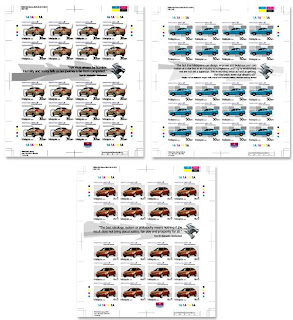
Gen2 StampsProton's commitment to Research & Development (R&D) and focus on automation addresses the challenge of a globalized industry. The new world class manufacturing plant in Tanjung Malim, Perak provides Proton with additional production capacity of 100,000 cars a year to the existing 250,000 a year at the factory in Shah Alam, Selangor. The unique modular design vehicle platform in Tanjung Malim allows for mixed production of different vehicle types, giving Proton the distinctive capability to make anything from small cars to the larger Multi-Purpose Vehicles (MPV). The Gen2, which was the first model to drive off these unique production lines, is fitted with a homegrown Gen2 Miniature Sheetengine, the CAMPRO, designed to incorporate other applications such as cam profile switching technology, variable valve timing and the use of natural gas. The Gen2 is now known in the market for its fuel efficiency. The R&D team is currently creating a new engine family of higher capacity to complement the CAMPRO.

With the right combination of technology and human innovation, Proton strives to achieve its dream of having Proton cars driven in every country around the world and its new spirit of Daring to Dare provides just the impetus.

Gen2 First Day CoverThe Proton's mark of pride found on every Proton car features a snarling tiger, displaying strength and courage, and symbolizing the company's boldness of competing in the highly aggressive world of international automotive manufacturing. Of the 11 car-producing nations around the globe, Malaysia, the smallest and youngest car manufacturer can today proudly lay claim to having successfully produced a car from scratch in only 20 years, half the time taken by Gen2 First Day Coverother well-established names in the motoring world. The Proton Gen2 has concluded the full circle of the company's evolution - from car assembler to a full-fledged automotive engineering company thriving on Malaysian talent, innovation and technology. Its launch in February 2004 also marked the unveiling of the Proton Platinum logo - the molten tiger - to signify premier products and services pledged to all customers of Proton.

Gen2 Stamps Sheet

Gen2 FolderTechnical Details

Date of Issue : 7-Mar-2005

Stamp Value : 30 Sen; 50 Sen; RM1.00

Stamp Size : 40 mm x 30 mm

Miniature Sheet Denomination : RM2.00

Miniature Sheet Size : 100mm X 70mm

Stamp Size in Miniature Sheet : 30mm X 40mm

Perforation : 14

Sheet Content : 20 Stamps

Paper : SPM Watermarked, Phosphor Coated

Gen2  Stamp BookletPrinting Process : Lithography

Printer : Percetakan Keselamatan Nasional Sdn. Bhd.

Stamp Designer : McCann Erickson (Malaysia) Sdn. Bhd

First Day Cover Value : 30 Sen

Presentation Pack Value : RM 4.00

Stamp Booklet Value : RM 3.00

Folder Value : RM 5.00


POS Malaysia 2 March 2005, Wednesday Press Release

SPECIAL STAMPS TO CELEBRATE PROTON’S TRANSITION INTO A NEW ERA WITH GEN.2

In collaboration with PROTON Holdings Berhad, Pos Malaysia Berhad (PMB) is issuing special stamps and First Day Covers featuring PROTON Gen.2 to the public on Monday, 7th March 2005.

The special stamps and First Day Covers will be launched by YAB Tun Dr. Mahathir Mohamad, PROTON’s Advisor at the Perdana Leadership Foundation Auditorium, Putrajaya on 21st March 2005, Monday.

“PROTON Gen.2 is Malaysia’s first model to be fitted with homegrown CAMPRO engine and it signifies the evolution of PROTON from a vehicle assembler to a full-fledged world class car manufacturer. Pos Malaysia Berhad is pleased to acknowledge this accomplishment and the stamps are a tribute to PROTON’s achievement,” said Dato’ Ikmal Hijaz Hashim, Managing Director/Chief Executive Officer of Pos Malaysia Berhad.

Launched in February 2004, PROTON Gen.2 is the first new car model to be produced at PROTON’s new world class manufacturing plant in Tanjung Malim, Perak. Its launch also unveiled the PROTON Platinum logo which signifies premier products and services pledged to all customers of PROTON. PROTON Gen.2 is now known in the market for its fuel efficiency.

Of the 11 car-producing nations around the globe, Malaysia, the smallest and youngest car manufacturer can proudly claim that is has successfully produced a car from scratch in only 20 years, half the time taken by other well-established automotive manufacturers. The stamps, 40mm x 30mm in size, are printed in sheets of 20 on SPM watermarked, phosphor coated paper and are available in the denominations of 30sen, 50sen and RM1. Miniature Sheet, 100mm x 70mm in size, is available with a stamp in the size of 30mm x 40mm at RM2. First Day Covers at 30sen each, Presentation Pack at RM4 each and Stamp Booklet at RM3 each can be purchased at all Post Offices nationwide. Folder at RM5 each is only available at selected Post Offices

Thursday, February 3, 2005

Migratory Birds of Malaysia Stamp

Migratory Birds StampsMalaysia's shores welcome millions of tourists every year. Among them, a very special group of visitors who need neither passports nor visas, although many have flown hundreds, or indeed, thousand of miles to be here.

There are Malaysia's migratory birds, from North Asia, Europe, and elsewhere.

Like many of their human counterparts, these visitors are escaping the onset of winter in the Northern Hemisphere. They are attracted to Malaysia by our warm, sunny climate and the abundance of food.

Migratory Birds First Day CoverAmong the most striking of these visitors is the Purple Heron (Ardea Purpurea). The Purple Heron seeks secluded wetlands and marshes throughout Peninsular Malaysia. It is known to be shy and reclusive, and is therefore difficult to spot, despite its large size (adults can attain up to 90cm in height). However, a glimpse of its exquisite plumage of chestnut and maroon, with a faint purplish tinge, makes the effort worthwhile.

Migratory Birds First Day CoverThe Crested Honey Buzzard (Pernis Ptilorhyncus) visits our country from its breeding grounds in remote Siberia. It soars gracefully on air currents, punctuating its flights with high-pitched calls as it seeks out bees' nests, from which it feeds on honey and bee larvae. These birds have been sighted at Sepang in Selangor, Tanjung Tuan in Melaka and Pulau Kukup in Johor.

Migratory Birds First Day Cover With MS Over printTo catch a glimpse of the Lesser Crested Tern (Sterna Bengalensis), take a drive to the coast, particularly near Langkawi. If you're lucky, you'll witness their spectacular plunging dives into the waves to catch fish. Another water lover, although perhaps less adventurous, is the Dunlin (Calidris Alpina), which leaves the bitter cold of Alaska and the Arctic Circle to walk delicately along Malaysian mudflats and sand bars, where it wades into shallow water looking for choice Migratory Birds Presentation Packmorsels. Surprisingly, the Brown-headed Gull (Larus Brunnicephalus), a visitor from the highlands of Turkmenistan and Mongolia, can be found well inland, in addition to its more expected haunts of open seacoasts, estuaries and rivers.

The Black-capped Kingfisher (Halcyon Pileata), ventures further north than any other kingfisher species during summer. From its home in China or Korea, it travels south in winter along our rivers, swamps and even the mangrove forests of Johor. This is one of the larger members of the kingfisher family, growing up to 28cm in length. Its powerful red bill snaps up insects, fish and frogs with equal ease, and is also used to excavate its riverbank nests.


Migratory Birds Miniature SheetMigratory Birds Miniature Sheet with Over print


Migratory Birds Miniature Sheet Over print MS with Left WatermarkMigratory Birds Miniature Sheet Over print MS with Right Watermark


Migratory Birds 30c Stamps SheetMigratory Birds 50c Stamps Sheet


Migratory Birds RM1 Stamps SheetTechnical Details

Date of Issue : 3-Feb-2005

Stamp Value : 30 Sen; 50 Sen; RM 1.00

Stamp Size : 40 mm x 30 mm

Miniature Sheet Denomination : RM2.00

Miniature Sheet Size : 70mm x 100mm

Stamp Size in Miniature Sheet : 40mm x 30mm

Perforation : 14

Sheet Content : 20 Stamps

Paper : SPM Watermarked, Phosphor Coated

Printing Process : Lithography

Printer : Percetakan Keselamatan Nasional Sdn. Bhd.

Stamp Designer : Reign Associates Sdn. Bhd.

First Day Cover Value : 30 Sen

Presentation Pack Value : RM 3.50

Folder Value : RM 5.00

Monday, January 24, 2005

The 5th Ministers' Forum on Infrastucture Development in the Asia-Pacific Region Stamp

Infrastucture Development StampsIn an effort to strategize and further strengthen cooperation in infrastructure development, Japan initiated a high level ministerial meeting attended by Ministers in charge of infrastructure in the Asia Pacific Region from October 26 to 28, 1995. Member countries include Australia, Brunei Darussalam, Canada, Chile, China, Colombia, Hong Kong, Indonesia, Japan, Korea, Malaysia, Mexico, New Zealand, Papua New Guinea, Peru, Philippines, Singapore, United States of America, Thailand and Vietnam.

Since then, this high-level ministerial meeting has been held biennially. The second meeting was held in Chile in 1997 followed by Hong Kong in 1999 and Indonesia in 2002.

Malaysia is the host country for the 5th Ministers' Forum on Infrastructure Development in the Asia-Pacific Region to be held in Kuala Lumpur from 24 to 25 January 2005. As a prelude to the Forum, an Experts' Meeting was held in the resort island of Langkawi, Malaysia from 29 to 30 November 2004.

Infrastucture Development First Day CoverObjectives

The infrastructure development cooperation to be directed towards improving the standard of living of the people, drive economic growth and to create prosperity in the Asia-Pacific Region.

In consideration of the geographic differences and levels of development in each country, cooperation to be directed to balance the level of infrastructure development by the way of using the appropriate expertise and technology.

Co-operation to be based on the principles of mutual assistance through exchange of information, experts and increasing collaboration between government and private sectors.

The objectives of the 5th Ministers' Forum is to reach a consensus on environmental issues, concrete and practical solutions on infrastructure development as well as the materialization of the bilateral or multilateral cooperation on a realistic scale.

Scope

The scope of cooperation will, among others include the following infrastructures: roads, railways, seaport, airport, irrigation systems, water supplies, sanitation, electricity, telecommunication, housing and cross-border projects.

Dates and Venues

The 5th Ministers' Forum will be held at the Putrajaya International Convention Center, Putrajaya. Preceding the Forum an Experts' meeting was held in Langkawi from 29 to 30 November 2004. The meeting prepares and recommends the materials for discussion in the Senior Officials' Meeting on 24 January 2005 prior to tabling at the Ministers' Forum on 25 January 2005.


Infrastucture Development 30c Stamp SheetInfrastucture Development 50c Stamp Sheet


Infrastucture Development RM1 Stamp SheetTechnical Details

Date of Issue : 24-Jan-2005

Stamp Value : 30 Sen; 50 Sen; RM 1.00

Stamp Size : 40 mm x 30 mm

Perforation : 14

Sheet Content : 20 Stamps with gutter

Paper : SPM Watermarked, Phospor Coated

Printing Process : Lithography

Printer : Percetakan Keselamatn Nasional Sdn. Bhd

Stamp Designer : Reign Associates Sdn. Bhd.

First Day Cover Value : 30 Sen

Folder Value : RM 5.00

Alltop, all the top stories
BlogMalaysia.com
All Malaysian Bloggers Project