Friday, July 7, 2006

50th Anniversary of FELDA Stamp

50 Years Felda StampsFelda 50 Years Celebration

Established with the primary intention of eradicating poverty and developing the federal land, Felda has achieved notable accomplishments over the years. It was 50 years ago when Felda started developing 811,140 hectares of land area with the help from 104,946 settles. In fact Felda's knack for managing the world's biggest oil palm estate has contributed to making Malaysia known to the world.

Starting out with rubber and oil palm plantation as its core focus, Felda has since moved onwards 50 Years Felda First Day Coverby diversifying its economic activities to include manufacturing, services, engineering, transportation, shipping, construction, information technology and communication, retail, tourism, herbs, security and catering. After 50 years of success, Felda is now ready to achieve further accomplishments for the next 50 years.

Cultivating the Seeds of Success (30 sen stamp)

The theme of the stamp is 'Cultivating the Seeds of Success'. The images of oil palm and rubber trees are to signify Felda's major plantation commodities which have helped Felda achieve its success.

Nation Building (50 sen stamp)

50 Years Felda 30c Stamps SheetThe theme of the stamp is 'Toward A Better Life'. The bungalow house is a true depiction of Felda's latest development in creating a housing settlement often referred to as Felda Jaya. The background features the original houses for settlers, a view of a typical settler's village and an aerial view of an oil palm estate; the main commodity that helped to enhance the quality of life of Felda's settlers.

Forging Success (RM1 stamp)

Upon reaching its first 50 years successfully, Felda continues to uphold to the nation's vision. The stamp features the old as well as the current Felda's office, Wisma Felda and Balai Felda at Jalan Perumahan Gurney, Kuala Lumpur. Felda aspires to create more success and milestones in the near future especially with the building of its new office tower as also seen in the stamp.

50 Years Felda RM1 Stamps Sheet50 Years Felda 50c Stamps Sheet


50 Years Felda FolderTechnical Details

Date of Issue : 7-Jul-2006

Stamp Value : 30 Sen; 50 Sen; RM 1.00

Stamp Size : 40 mm X 30 mm

Perforation : 14

Sheet Content : 20 Stamps

Paper : SPM Watermarked, Phosphor Coated

Printing Process : Lithography

Printer : Percetakan Keselamatan Nasional Sdn. Bhd

Stamp Designer : Fluorescent Squid Sdn Bhd

First Day Cover Value : 30 Sen

Folder Value : RM 5.00


Thursday, June 22, 2006

50th Anniversary Dewan Bahasa Dan Pustaka Stamp

Dewan Bahasa Dan Pustaka StampsOn 22nd June 2006, Dewan Bahasa dan Pustaka (DBP) celebrates its 50th Anniversary. Since its inception half a century ago, DBP has always been regarded as the pillar of success in the development of the Malay Language. During that period, from Bukit Timbalan, Johore Bahru, to Jalan Young, Kuala Lumpur, and today at Jalan Dewan Bahasa, DBP has successfully overcame various challenges and obstacles in carrying its responsibilities in overseeing the development of the Malay Language as the national and official language of the nation - the language that gives a sense of pride and identity to the colourful multiethnic and multicultural society of Malaysia.

Dewan Bahasa Dan Pustaka First Day CoverDBP was established on 22nd June 1956 in Johore Bahru as a department under the Ministry of Education. Its establishment was aimed at developing the Malay language as the national and official language as the nation was moving towards independence. The following year it was relocated to Jalan Young before moving to Jalan Lapangan Terbang Lama five years later. Today, DBP operates from a 33 storey building at Jalan Dewan Bahasa (formerly Jalan Lapangan Terbang Lama). Besides its headquarters in Kuala Lumpur, DBP now has branches and regional offices in Kota Kinabalu, Kuching, Kota Bahru, Bukit Mertajam and Johore Bahru to help in the plans to develop the Malay language and literature in the various regions.

Dewan Bahasa Dan Pustaka Stamps Sheet50sen Stamp

The mural on the facade of DBP Balai Budaya Tun Syed Nasir symbolizes the unity of the Malaysian people who espouse the sentiment "Language is the Soul of the Nation" amidst the development of culture, education, economy, science and technology, expressed through one language, which is also the country's sole official language. The mural was composed by Ismail Mustam, an artist who was once a staff of the organization in 1961.

50sen Stamp

The logo of DBP comprises four elements - the palmyra palm frond set in the centre symbolises the writing og the old while the bracken or large fern leaf represents the instrument used to write on it, the book and nib at the base of the Palmyra leafsymbolises the publishing and writing activities of more recent times. These four elements symbolises the responsibilities of DBP as a body that develops the Malay language, literature and knowledge through writing and publishing. The logo was drawn in 1957 by Hoessien Enas.

RM1 Stamp

The stamp design reflects the recent progress of DBP in the era information and communication technology in the publishing industry.


Dewan Bahasa Dan Pustaka FolderTechnical Details

Date of Issue : 22-Jun-2006

Stamp Value : 50 Sen ( Se-tenant ); RM 1.00

Stamp Size : 40 mm X 30 mm

Perforation : 14

Sheet Content : 20 Stamps

Paper : SPM Watermarked, Phosphor Coated

Printing Process : Lithography

Printer : Percetakan Keselamatan Nasional Sdn Bhd

Stamp Designer : Hazel Design

First Day Cover Value : 30 Sen

Folder Value : RM 5.00

Thursday, May 25, 2006

Fresh Water Fish Series III Stamp

Fresh Water Fish Stamps Fresh Water Fish Series III

When we talk about fresh water fish, there is not much information that we know on their habitat except by conducting an in-depth study of their environment. We might be getting numerous tales from enthusiastic anglers of their encounters and experiences. As we all know, every single species differs from their physical appearances, shapes and colors. The complexity of their multiple shapes, colors and behaviors somehow, reflects their natural habitats.

Fresh Water Fish Series III is specially produced to provide information on the uniqueness and specialty of these precious fresh water fishes. To name a few, species such as 'temoleh', 'sebarau', 'patin' and 'keli' which are much loved by anglers to the kampong folks' favorite fish dish like the 'belida' are included. Each of them has its very own attraction and will definitely add colors to the world of fresh water fishes. Undoubtedly these countless species will bridge the relation between human, nature and ecology.

Fresh Water Fish Miniature SheetJelawat (Leptobarbus hoevenii)

Jelawat is a carp and can be found mostly in large rivers and streams. It can also be found in Pahang and Perak. With elongated body, broad head and flattened top, the upper half of the body is light green while its belly and lower half is white, with a touch of red at the tip of its lower fins. It feeds on shrimps, insects larvae, and parts of leaves. This fish is known for its delicious taste and is one of the most expensive and puts up quite a fight to the anglers. They can also be found in Thailand, Sumatra and Borneo.

Patin (Pangasius sp.)

Patin can be found in rivers and river mouths. It is a popular fresh water fish and is reared commercially for aquaculture activities. It has a mix of greenish-greyish back and light green color on the upper part of its head with light shiny belly and bumpy head. They can also be found in India, Bangladesh, Burma, Java and Thailand. It feeds on fish remains and decayed organics.

Fresh Water Fish First Day CoverSebarau (Hampala macrolepidota)

Sebarau can be found at rivers and streams with strong currents, with sandy to muddy waters. This fish is a valuable fresh water recreation fish. Known for its fighting spirit and it aggressively fights the anglers. With elongated and compressed body and fins in dark red and yellowish color, as well as large scales with blackish linings and silverish grey body makes Fresh Water Fish First Day CoverSebarau an attractive fish. Thrives on insects fragments and fish remains.

Temoleh (Probarbus jullieni)

This fish can be found in Perak and Pahang and it is said to be the largest species of the Cyprinids in Peninsular Malaysia. Temoleh thrives on shelled mollusks and water plants. The body has 7 narrow horizontal black stripes with its upper half of the body in olive and lower half creamy yellow color. The head is in bright greenish yellow with fins in light pink. These wonderful colors are complimented by a blackish end tail. Temoleh is truly a beautiful fresh water fish.

Fresh Water Fish Presentation PackBaung (Mystus nemurus)

Baung can be found at zones to the upstream of rivers and rice fields. They do not have much preference for clear of muddy water and is a threat to lobsters (udang galah) that lives in ponds. Its color is in formalin dusky white with serrated spine. It eats a variety of food including shrimps, insects, crabs and fish larvae. The distribution of this fish also covers Java, Sumatra, Singapore, Borneo and Thailand.

Ikan Keli (Clarias Batrachus)

Easily found all over Malaysia especially rice fields, swamps around the rice fields, riverbanks, drains, and old mines. They are bottom dwellers but very frequently come to the surface of the water to draw in fresh air. The skin is smooth, brownish green on the upper part of the body and lighter below. The body is elongated, compressed at the back with its head moderately flattened.


Fresh Water Fish Stamps SheetTechnical Details

Date of Issue : 25-May-2006

Stamp Value : 30 Sen, 50 Sen ( 2 Designs ), RM 1.00

Stamp Size : 40 mm X 30 mm

Sheet Content : 20 Stamps

Miniature Sheet Value : RM 5.00

Miniature Sheet Size : 100mm x 70mm

Stamp Size on Miniature Sheet : 70mm x 35mm

Perforation : 14

Fresh Water Fish FolderPaper : SPM Watermarked, Phosphor Coated

Printing Process : Hologram And Lithography

Printer : Percetakan Keselamatan Nasional Sdn Bhd

Stamp Designer : Hazel Design

First Day Cover Value : 30 Sen

Presentation Pack Value : RM 4.50

Folder Value :RM 5.00

Wednesday, April 26, 2006

Mountains Of Malaysia Stamp

Mountains Stamps Mountains have always exerted a powerful influence on the human imagination - their lofty heights inspire dreamers and storytellers, and have challenged adventurers through the ages. Malaysia's mountains are no exception. Peninsular Malaysia's mountains like Gunung Jerai and Gunung Ledang, bear a rich folklore, and Sabah's highest peak, Gunung Kinabalu, is revered by the local Kadazandusun populace as the resting place of their ancestors.

Beyond the mystique of our mountains, there is an equally fascinating reality. With increasing altitude climate gradients are created, which Mother Nature has taken advantage of to create Mountains Miniature Sheetsome of Malaysia's most unique flora and fauna. In the heat of the tropics, our mountains have become cool islands of incredibly rich biodiversity. Every year, tourists from all over the world come to conquer the slopes of Malaysia's peaks. Our task is not just to preserve the challenge they present to climbers, but the equally important challenge of keeping their beauty and diversity unspoilt. For nature lovers, birdwatchers, climbers, botanists - and modern-day dreamers and storytellers - they are truly our "highest" national treasure.

Mount Kinabalu (Gunung Kinabalu)

Mount Kinabalu is among South-East Asia's tallest mountains, towering 4,095 meters above Kinabalu National Park in the heart of Sabah. The mountain's sheer height means it supports ecosystems ranging from tropical forest to sub-alpine conditions. The majority of Borneo's rarest plants, mammals, birds, amphibians and invertebrates live on the slopes of Gunung Kinabalu. Despite its imposing presence, the main peak is actually fairly straightforward to climb, although Gunung Kinabalu's lesser peaks will challenge even experienced mountaineers. The most Mountains First Day Coverpopular trek is the two-day Summit Trail, which winds through cloud-covered forest where orchids, pitcher plants and rhododendrons bloom, and then beyond to a surreal world of granite peaks and steep cliffs. In the year 2000, the mountain and its surrounding area was gazette as Malaysia's first World Heritage Site - a fitting tribute to Mount Kinabalu's uniqueness and importance.

Mountains First Day CoverMoung Ledang (Gunung Ledang)

A recent film has put the name of this mountain on everyone's lips; yet it has always been renowned among the local population of Johor, who have passed tales of its resident princess. 'Puteri Gunung Ledang' from generation to generation. Although the princess was well-known for her riddles, the enduring charm of Mount Ledang is no mystery at all. It is a popular spot for jungle trekking and picnicking. As one near the summit, there are areas of undisturbed mossy forest with orchids and pitcher plants. From the peak, on a clear day, one enjoys an unrivalled view of the Straits of Malacca, framing the islands of Sumatra in the distance.

Also known as Mount Ophir, Gunung Ledang is the highest mountain in Johor at 1,276 meters and appears to be one of Malaysia's most visited mountains. Another attraction to be found in Gunung Ledang is a 50-meter waterfall, which cool water cascades onto large boulders, splitting into rushing rapids and culminating in a large sandy pool. The 'Puteri Waterfalls' is a major tourist attraction in Johor.

Mount Jerai (Gunung Jerai)

Much like Gunung Ledang to the South, Kedah's Gunung Jerai is home to many fascinating local legend. It was once reputed to be the abode of 'Raja Bersiong' (the 'King of Fangs') whose private bathing pool has been said to be located in the vicinity. Whether one embraces these legends or not, the real historical significance of Gunung Jerai is indisputable. Even before the Malacca Sultanate became famous, Indian and Arab merchants had established footholds in the Malay Peninsula at the Merbok estuary in Jerai's foothills.

Mountains Maximum CardFor the modern day traveler, Gunung Jerai is still enticing. Just a short drive away from Alor Star, the mountain rewards visitors with numerous picnic spots and natural attractions. The Sungai Teroi Forest Recreation Park is a calming retreat festooned with rhododendrons, orchids, pitcher plants, and many varieties of ferns and herbs. On a clear day atop the peak, visitors can glimpse the magnificent view of the gently rolling padi fields of Kedah, stretching up to Perlis, and the islands of Penang in the south and Langkawi in the north-west.

Mount Mulu (Gunung Mulu)

Gunung Mulu is the second highest peak in Sarawak, standing at 2,376 meters. With its sister peaks, Gunung Api (1,750 meters) and Gunung Benarat (1,585 meters) it dominates Gunung Mulu National park; yet what lies within and beneath these mountains is just as impressive as what lies above. The highlights of this magnificent natural wonder are record-breakers in their own right: the world's largest cave passage (Deer Cave), the world's largest natural chamber (Sarawak Chamber), and the longest cave in Southeast Asia (Clearwater Cave). Over 200 km of Mulu's cave passages have been surveyed, but this is thought to represent just 30-40% of the actual total.

With its deeply-incised canyons, wild rivers, rainforest-covered mountains, spectacular limestone pinnacles, cave passages and decorations, Mulu has outstanding scenic values. A must-see attraction is the 'Pinnacles' - dramatic limestone spikes, reaching up to 45 meters, that adorn the slopes of Gunung Api.

Mount Tahan (Gunung Tahan)

Gunung Tahan, located in Taman Negara national park, is Peninsular Malaysia's highest peak at 2,187 meters. It is surrounded by some of the Earth's oldest rainforests, estimated to be more than 130 million years old. There are two known ways of conquering the summit of Gunung Tahan. One is through Kuala Tahan, and another from Merapuh, Kelantan. The route from Merapuh is the shorter route but still rewards climbers with the same impressive vistas over the Tahan Range.

The adventurer's unofficial companions for this spectacular trek will be over 10,000 species of plants, 350 species of birds, and hundreds of mammal species. Patience and luck may reward you with a glimpse of mouse deer, barking deer, tapirs, wild boards, elephants, leopards, and even for the exceptionally fortunate, tigers. Despite the constant inflow of local and international tourist, careful conservation has ensured that its age-old richness remains largely intact.
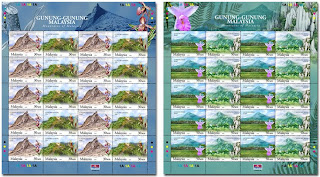


Mountains SheetTechnical Details

Date of Issue : 26th April 2006

Denomination : 30 sen setenent & 50 sen setenent

Stamp Size : 40mm x 30mm

Miniature Sheet Denomination : RM2.00
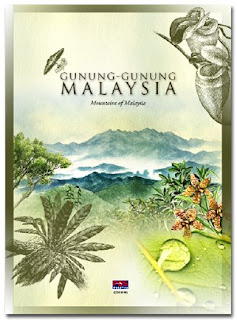
Mountains FolderMiniature Sheet Size : 100 mm X 70 mm

Stamp Size in Miniature Sheet : 50 mm X 40 mm

Perforation : 14

Sheet Content : 20 Stamps

First Day Cover Value : 30 Sen

Perforation : 14

Paper : Watermarked SPM, Phosphor Coated

Printing Process : Embossed Technique and Lithography

Printer : Percetakan Keselamatan Nasional Sdn. Bhd.

Designer : Reign Associates Sdn. Bhd.

Maximum Card: 50 sen

Tuesday, March 28, 2006

Rare Fruits III Stamp

Rare Fruits StampsRare Fruits of Malaysia

Malaysia possesses a rich diversity of tropical fruits. Besides the commercial fruits, there are many other fruit species which are grouped under rare fruits. Many of the rare fruit species have great potential but they are under exploited. The production of rare fruits is rather limited due to low number of trees available for each species. However, some of the potential rare fruits are sold at night markets, "pekan sehari" or along the roadsides. Most of the rare fruits are seasonal, but there are also species that are non-seasonal, producing fruits throughout the year.

Rare Fruits Miniature SheetThey provide nutritional benefits and some of these species have unique medicinal value. Furthermore, due to its rarity, it provides good source of income.

These rare fruits are usually grown in home gardens or orchards. Among the fruits that can be found in home gardens are Cermai, Ceri Terengganu, and Durian Nyekak. Jentik-jentik grows in the wild and can be found in forests. Beruas is now being planted as landscaping trees in gardens or pathways.

Considered as treasures of the forests, it is important to cultivate the public's awareness on the value and importance of these rare fruit species as well as ensure that effective conservation and sustainable utilization of the diversity is undertaken so that the future generation is able to appreciate their uniqueness and specialty.

Rare Fruits First Day CoverTerap Bulu (Artocarpus Sericicarpus)

Terap bulu is famous in Sarawak. The fruit is large, weighing between 450g - 800g and resembles that of nangka or cempedak. The shape is oval and is slightly orange in color with a strong smell. The whole fruit is covered with long, coarse hair and when ripe the fruit is soft and can be easily opened while the flesh and stalk can be easily pulled from the skin. The flesh, consisting Rare Fruits First Day Coverof many small segments is white, soft, sweet, juicy and fragrant. Seeds can be eaten by frying without oil or boiled.

Cermai (Phyllanthus Acidus)

The small sized tree bears fruits in bunches from the branch or stalks and are non-seasonal. The fruit is small, measuring about 2 cm in width and 1.5 cm in length. When ripe, the fruit is yellow, Rare Fruits Presentation Packtranslucent and shiny. The shape of the fruit is round and slightly flattened. The surface of the fruit has 6-8 lobes while the flesh is usually sour in taste with stony seed. Besides eating fresh, the fruit can be pickled, made into dried candy and used in rojak mixture.

Beruas (Garcinia Hombroniana)

The shape of the Beruas tree and its leaves very much resemble that of the mangosteen trees. The flowers are scented and blooms at the end of the branch in clusters of 6-8 blooms or flowers. Fruits are 4cm - 5cm in width and round shaped with pointed tips attached with the stigma. The skin is dark, red and shiny while the thin flesh consists of 8-10 segments and is white in color as well as sour in taste. The tree can be used as beautiful landscape plants.

Ceri Terengganu (Lepisanthes Alata)

The tree is non-seasonal and produces fruit throughout the year. The fruits are arranged closely and attractively in a big bunch of cluster of which each bunch consists of about 20 fruits. The fruits, about 2cm - 3 cm in width are dark red, shiny and round with pointed tip. Each fruit contains 1-3 pieces of seeds and its flesh is soft and tastes fairly sweet. The tree is small but can reach medium height. Its canopy spreads out and the purplish color of the young leaves adds to the attractiveness of the tree. Due to this Ceri Terengganu is usually planted for landscaping purposes.

Rare Fruits SheetJentik-Jentik (Baccaurea Polyneura)

The trees are large, reaching up to more than 30 meters in height while the fruits are borne in large and long clusters hanging down from the branches. A bunch contains up to 10-20 fruits that are small in size with 2 cm in width and 2.5 cm in length and are orange in color. The skin is hard and brittle and is easily broken when clicked with fingers. The flesh, consisting of 1-3 segments is shiny and dark orange in color with sweet and acidic taste. The tree is seasonal, produce flowers and fruits only once a year.

Nyekak (Durio Kutejensis)

Nyekek can be found in the states of Sarawak and Sabah. The tree is medium in height, reaching 30 meters tall. Leaves are dark green on the upper surface with golden underside. Nyekak can be easily recognized through its big, dark red flowers. The fruit shape varies from round to oval and oblong while its size varies from small to big at 8 cm up to 13 cm in length and weighing from 300g to 940g. The skin is yellow with short and sharp thorns while the flesh is yellow to orange in color and can reach up to 7 mm in thickness. Nyekak fruit tastes creamy, sweet and less pungent in flavor whereas the seed is dark brown and shiny. An interesting trait of the fruit is that the flesh has no odor and it does not stick to the fingers. Another important characteristic of the Nyekak is that the calyx and its filaments are firmly attached to the base of the fruit.


Rare Fruits FolderTechnical Details

Date of Issue : 28-Mar-2006

Denomination : 30 Sen; 50 Sen, RM 1.00

Stamp Size : 29 mm X 34 mm

Miniature Sheet Value : RM 1.00 X 2

Miniature Sheet Size : 100 mm X 70 mm

Stamp Size in Miniature Sheet : 29 mm X 34 mm

Perforation : Elliptical(14)

Sheet Content : 20 stamps

Paper : SPM,Watermarked, Phosphor Coated

Printing Process : Lithography

Printer : Percetakan Keselamatan Sdn Bhd

Stamp Designer : Hazel Design

First Day Cover Value : 30 Sen

Presentation Pack Value : RM 4.30

Folder Value :RM 5.00


Tuesday, February 14, 2006

100th Anniversary of National Audit Institution Stamp

Audit Negara Stamps History of National Audit Institution

The Institution of Audit was first established in Malaya during the British Colonial administration in the early 19th century. During this period, the office of the Auditor General was formed separately in both the Federated Malay States and the Straits Settlements. In the year 1906, the first Auditor General of The Federated Malay States was appointed. He was responsible for the audit function of the four states centered in Kuala Lumpur. Both the institutions were merged in the year 1932 and placed under the Director of Colonial Audit, London. However, auditing and the preparation of the audit report were carried out by the Auditor of the Straits Settlements and the Federated Malay States, a newly established position in Kuala Lumpur. In 1957, when the Federation of Malaya attained its independence, the post of Director of Audit was abolished and the post of the Auditor General of the Federation of Malaya was established. The appointment as well as the responsibilities of the Auditor General is stipulated under Article 105 of the Federal Constitution and the Audit Act 1957.

National Audit Academy

Under the new organizational structure introduced in 2002, the Training Branch has been placed under the Research and Training Division, Corporate Management Sector and is responsible for managing, planning and implementing the training needs of the National Audit Department. The Training Program supports the Department's Strategic Plan that is to enhance the quality of audits, the capability of auditors to give advise and the mastering of ICT as well as nurturing excellence in the work environment. This branch coordinates Training Programs which encompasses various aspects in auditing, accounting, ICT and management. To strengthen our Training Program, the National Audit Academy was built at the cost of RM42.42 million. The Academy is located in the township of ENSTEK Seremban, Negeri Sembilan. This Academy was launched on 24 November 2005 and provides facilities such as classrooms, hostels, auditorium, quarters, mosque and recreational utilities.

Audit Negara First Day CoverNational Audit Department Logo

The concept for the new logo is based on a combination of a stylized letter 'a' and modern graphic element. The letter represents Audit, which in turn is the main function of the National Audit Department. The letter is also the first letter in the alphabet and mirrors organizational excellence. The orbit on the other hand depicts the readiness of the National Audit Department to face the challenges of globalization while the diamond symbol represents the steadfastness of this organization in realizing the Nation's Vision. The yellow color represents the sovereignty of the king, the source of power of the National Audit Department. Maroon symbolizes the image and identity of the National Audit Department and blue represents the spirit of teamwork that is the philosophy of the employees of the Department. Red on the other hand, symbolizes the high spirit of the employees of the National Audit Department.

The first National Audit Department logo consisted of a shield and a divider with 13 stars representing the 13 different states in Malaysia. The Parliament Building is featured under the stars representing the place where the report of the Auditor General is tabled. The scales on top of the stars signify the principles of justice on which the activities of the Department are based. The book, keys and pen symbolize the accounting record for public funds kept by the Treasury and audited by the Department. This logo was used for 30 years until the year 2002.

Audit Negara SheetAuditor General's Reports

From 1906 until 1959 the Auditor General's Reports were prepared in English. It was only in 1960 that the Auditor General's Report was prepared in two languages; English and Malay. Gradually after 1960, the audit reports were prepared in Malay. The earliest record of printed Auditor General's Report was in 1920. The format of the report gravitated more towards the verification of the financial statements figures and issues related to those statements. In the year 2000, the National Audit Department revised the format and contents of the Auditor General's Report by emphasizing on balanced reporting. Through this format, the Auditor General's Report not only highlight on the weaknesses of Governmental Agencies, but also the positive actions and improvements that were carried out. This approach has so far fostered better cooperation between auditors and auditees and successfully created a conducive audit environment as well as improving the process of auditing and reporting.


Technical Details

Date of Issue : 14-Feb-2006

Denomination : 30 Sen; 50 Sen ( 2 Designs )

Stamp Size : 40 mm X 30 mm

Perforation : 14

Sheet Content : 20 Stamps

Paper : SPM Watermarked, Phosphor Coated

Printing Process : Lithography

Printer : Percetakan Keselamatan Nasional Sdn. Bhd.

Designer : Creative & Communications House Sdn. Bhd.

First Day Cover Value : 30 Sen

Folder Value : RM 5.00

Alltop, all the top stories
BlogMalaysia.com
All Malaysian Bloggers Project