Wednesday, September 28, 2005

Rare Reptiles Of Malaysia Stamp

Rare Reptiles StampsToday, there are hundreds of species of reptiles in Malaysia. The major groups being crocodiles, turtles, snakes, lizards and frogs. All reptiles are cold-blooded, which is why they warm themselves in the sun, and have bodies covered in dry, horny scales. Some reptiles lay eggs; others give birth to live young.

All reptiles are vertebrates, animal with backbones. They are low to the ground, and all except snakes and a few lizards have four legs.

The size of reptiles can range from the very tiniest of frogs that are smaller than a person's Rare Reptiles Miniature Sheetthumbnail to crocodiles that are several meters long. An astonishing fact of these species is their ability to glide from tree to tree or from a tree to the forest floor.

The Harlequin Monitor (Varanus dumerilii) is a fairly large monitor that can demonstrate an incredible shyness when observed. The juvenile Harlequin Monitor tends to be more colorful than the adult. This is due to its bold orange-colored head, which however disappears with growth. Its diet includes insects such as termites, ants, cockroaches and so on. This lizard inhibits Southern West Malaysia, Sumatra and Borneo.

The rare Rough-necked Monitor (Varanus rudicollis) is characterized by its greatly enlarged, strongly kneeled neck scales that are arranged in 10-12 longitunal series. It is dark with crossbands and reddish areas on the side of the neck. Reaching 120 cm in total, this arboreal monitor inhibits Southern West Malaysia and Borneo.

The Great Anghehead Lizard (Gonocephalus grandis) is amazing to observe in the wild because of its incredible camouflage when blending into the environment. A crest runs down the length of the male lizard's body, and some have spikes over the large dewlaps. This lizard is usually blue in color, but can vary in different situations. This species occurs in the far south of Thailand, Malaysia, Sumatra and in Borneo.

Rare Reptiles First Day CoverEstuarine crocodile (Crocodylus porosus), the largest of all the crocodile species, can be found in such extensive places that range from Eastern India, Southern China through Malaysia and the Philippines to Northern Australia and the Pacific Islands. This crocodile usually inhibits river estuaries and coastal regions including mangroves and remote beaches. It feeds on various vertebrates including fish, water birds and various mammals.
Rare Reptiles First Day Cover
The Five-banded Gliding Lizard (Draco quinquefasciatus) is a medium-sized lizard that inhibits lowland primary rainforest, often close to swamps or other water bodies. This species is easily identified by the five dark bands across the live green dorsum and patagium. It often stays at the base of tree trunks to feed on ants, termites and other small insects. This species ranges from Southern Thailand and Peninsular Malaysia, to Sumatra and Borneo.


Rare Reptiles Stamps SheetTechnical Details

Date of Issue : 28-Sep-2005

Stamp Value : 30 Sen ( 2 Designs); 50 Sen; RM1

Stamp Size : 40 mm X 30 mm

Miniature Sheet Denomination : RM2.00

Miniature Sheet Size : 70mm X 100mm

Stamp Size in Miniature Sheet : 40mm X 50mm

Perforation : 14

Sheet Content : 20 Stamps

Paper : SPM Watermarked, Phosphor Coated

Printing Process : Lithography

Printer : Percetakan Keselamatan Nasional Sdn. Bhd

Stamp Designer : Reign Associates Sdn. Bhd

First Day Cover Value : 30 Sen

Folder Value : RM 5.00

Tuesday, August 30, 2005

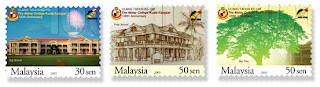
100th Anniversary of Malay College, Kuala Kangsar Stamp

100 Years of MCKK StampsThe Malay College Kuala Kangsar (MCKK) is the premier and first fully-residential school in Malaysia. Established on 2nd January 1905, it was originally known as the Malay Residential School of Kuala Kangsar. It was an all Malay boys' school located in the Royal Town of Kuala Kangsar, Perak.

The school was the brainchild of Mr. R J Wilkinson, then Inspector of Schools for the Federated Malay States. In a letter to the Resident-General dated 24th February 1904, he wrote about "establishing at a suitable locality in the F.M.S., a special residential school for the education of Malays of good family and for the training of Malay boys for admission to certain branches of Government service".

100 Years of MCKK Miniature SheetIts formation was enthusiastically supported by the then Rulers of the Federated Malay States namely Sultan Idris Murshidul 'Adzam Shah of Perak, Sultan Alaiddin Sulaiman Shah of Selangor, Yam Tuan Tuanku Muhamad Shah of Negeri Sembilan and Sultan Ahmad Al-Mu'adzam Shah of Pahang.

Since its inception, more than 5,000 boys (and 2 girls) have had the privilege to enter the gates of The MCKK. Though it was initially founded to educate the Malay elites, it changed dramatically as a result of rising Malay nationalism since 1947. Today, selected Malay boys from all walks of life and aged from 12 to 17 from all over Malaysia are educated in The MCKK.

The MCKK has been the school for many prominent Malaysian such as Kings, Sultans, Prime Ministers, Ministers as well as senior officials in the Government and leading figures in the private sector. The MCKK boys would undoubtedly fill many of the pages of Who Is Who in Malaysia.

MCKK celebrated its Centennial Anniversary on 26th March 2005. Attended by royalties, dignitaries, Old Boys and townspeople, The Malay College Kuala Kangsar or fondly referred to as the Eton of the East was also declared a National Heritage by His Majesty the Yang di-Pertuan Agong. His Majesty re-affirmed that the Malay Rulers "...shall remain as Royal Patrons of The Malay College Kuala Kangsar for as long as the sun, the moon and the stars move across the Heavens."

The most recognizable, oldest and famous landmark of MCKK is none other than the imposing 2 storey building with pseudo Greco-Roman architecture fronted by a vast playing field. It is known as the Big School. The official opening of the building took place on Saturday 11th December 1909 and officiated by Sultan Idris Murshidul 'Adzam Shah, the Sultan of Perak. In 1955, the West and East Wings were added and together they make up what is now called the Big School. The Big School is currently the main hostel for the seniors. The Big School remains as a majestic edifice of The Malay College.

100 Years of MCKK First Day CoverThe Prep School (Preparatory School), built in 1912, is smaller but with equally prominent features. Built in pseudo Greco-Roman architecture too, this 2 storey "L" shaped building houses the first year students. Here, students are taught and prepared for their future life in MCKK. The Prep School is the only hostel located within the present Administrative Block. The hostel has its own dining hall, common room and playing fields.
100 Years of MCKK First Day Cover
A prominent feature of the Big School is the Big Tree. Located in front of the East Wing, it was said to be as old as the school itself. It is of the Samanea saman species, and commonly known as the rain tree, coco tamarind, acacia preta, French tamarind, saman, monkey pod or 'pokok pukul lima". It came from tropical America, and has a large dome-shaped canopy. It can grow up to 180 feet tall with a crown up to 240 feet across. As the leaves age, the color changes from pale green to bright yellow and then to a golden color before shedding. The flowers are small pinkish green.

To the boys of MCKK, Big Tree is more than just a tree. It is a monument that every living Old Boy can easily relate to. Throughout its existence, it has been a landmark for many a congregation, and serves as both a meeting and parting point. Stories pertaining to Big Tree, true or mythical, are plentiful.


100 Years of MCKK Stamps SheetTechnical Details

Date of Issue : 30-Aug-2005

Stamp Value : 30 Sen; 50 Sen ( 2 Designs )

Stamp Size : 40 mm X 30 mm

Miniature Sheet Value :50 Sen ( 4 Designs )

Miniature Sheet Size : 100 mm X 70 mm

Stamp Size in Miniature Sheet : 22 mm X 51 mm

Perforation : 14

Sheet Content : 20 Stamps

Paper : SPM Watermarked, Phosphor Coated

100 Years of MCKK FolderPrinting Process : Lithography

Printer : Percetakan Keselamatan Nasional Sdn. Bhd

Stamp Designer : Reign Associates Sdn. Bhd

First Day Cover Value : 30 Sen

Folder Value : RM 5.00

Tuesday, August 9, 2005

Traditional Water Transport Stamp

Traditional Water Transport StampsTraditional Water Transport

The first form of water transportation is the log. The rider sites on it with his legs used as oars. The rider also has the option of laying facedown Traditional Water Transport Miniature Sheetwith both his arms and legs used as oars. As time progressed, people advanced and had learnt to modify their oars by tying three or four pieces of wood together using fiber rope, rattan or ferns. The tied wood pieces form a flooring that floats on the water, and in turn becomes a RAKIT (raft). More modern water transportation such as carving out the center of a log into a SAMPAN is witnessed later on. The sampan is built in such a way that its entire frame consists of the ribs, the bow and the keel.

'Perahu Kotak' (Box Boat)

The box boat is built using pieces of planks. Its structure is simple as its frame is built without a bow, keel and 'papan lepang' and short 'rangka kun'. It is used by village folks as a vehicle for transportation in shallow, coastal waters of the river and to carry personal items.

Sampan

The entire sampan is made from pieces of plank, Traditional Water Transport First Day Coverand exists in various sizes. A small sampan of approximately 2 to 3 meters long can accommodate 2 to 4 people. Most sampans are used on rivers as a form of transport. The sampan's belly is wide and its bow slopes steeply.

'Rakit Buluh' (Bamboo Raft)

Bamboo rafts are the most common water transportation being used. They range from simple 1-man rafts to larger ones that serve different Traditional Water Transport First Day Coverpurposes. The larger rafts are made from 8-10 culms of bamboo measuring approximately 3 meters in length. Even larger ones are available too - these are 2-layered rafts amounting to 6-12 meters in length. These massive rafts are capable of transporting up to 6 persons and 450 kg of jungle produce. Some of these huge rafts may even contain a built-in temporary shelter, enabling passengers to get a good rest during long and taxing journeys.

Traditional Water Transport Presentation Pack'Perahu Batang' (Long Boat)

The long boat is fashioned out of a log that is split lengthwise into two, and then carved into the shape of a boat. The inside surface is gouged out from the bow to the keel to make a sufficiently large hole to accommodate up to four or five boatmen. The long boat is used by riverside dwellers as a means of transportation to carry passengers and daily necessities.


Traditional Water Transport Stamps SheetTechnical Details

Date of Issue : 9-Aug-2005

Stamp Value : 30 Sen; 50 Sen; RM 1.00

Stamp Size : 40mm X 30mm

Sheet Content : 20 Stamps

Miniature Sheet Denomination : RM2.00

Miniature Sheet Size : 100mm X 70mm

Stamp Size in Miniature Sheet : 40mm X 50mm

Perforation : 14

Paper : SPM Watermarked, Phosphor Coated

Traditional Water Transport FolderPrinting Process : Lithography

Printer : Percetakan Keselamatan Nasional Sdn. Bhd.

Designer : Reign Associates Sdn. Bhd.

First Day Cover Value : 30 sen

Presentation Pack Value : RM 3.50

Miniature Sheet Value : RM 2.00

Folder Value : RM 5.00


Wednesday, July 27, 2005

Protected Mammals Series III Stamp

Protected Mammals StampsMalaysia's civets, otters, weasels, martens and porcupines may not be as well-known as other Malaysian mammals such as the elephant, tiger or tapir with which they share our forests. They are, nonetheless, interesting and often unusual animals, ranging from treetop to aquatic acrobats, from stealthy nocturnal hunters to peaceful vegetarians.

The Yellow-Throated Marten (Martes flavigula) ranks among Malaysia's most elegant and graceful mammals. The Malaysian variant has a brown belly and flanks, while the chest and throat are a striking creamy-white to canary Protected Mammals Miniature Sheetyellow. Its diet includes insects, birds (and their eggs), lizards and amphibians.

The Large Spotted Civet (Viverra megaspila, Blyth) is believed to forage entirely on the ground as it has never been observed on trees. It eats small mammals, eggs and some vegetation. It is a solitary animal and tends to be aggressive towards members of its own species. Large Spotted Civets are found in lowland forests throughout Malaysia and are best spotted at night as they spend the day sleeping in thick vegetation.

The Malay Weasel (Mustela nudipes) is known locally as 'pulasan tanah'. This species can be found in both Peninsular Malaysia and Borneo, although it is never present in large numbers. Although small physically, it is, like most weasels, a fearless predator which tackles birds, mice and frogs. It gives birth to 1-4 young ones.

Protected Mammals First Day CoverMalaysia's freshwater and coastal areas, especially mangroves and peat swamp forests, are home to the Hairy-Nosed Otter (Lutra sumatrana, Gray). It feeds on crustaceans and fish, being an excellent swimmer with fully webbed feet. It is rarely encountered, but has been recorded in Penang's waters; there may also be a population in Kuala Gula, Perak. It has been observed that the male likes to take part in the rearing of the young.

Protected Mammals First Day CoverThe Long-Tailed Porcupine (Trichys lipura) is the smallest of the four Malaysian porcupine species and can be mistaken at a glance for an oversized rat - until one notices the large tuft of stiff hairs at the end of its long tail. The Large Porcupine (Hystrix brachyura) on the other hand is a large species, growing up to 7 kg in weight. Porcupines are largely nocturnal animals and are peaceful unless provoked by a predator into using their sharp quills in self-defense. Both of these porcupines can be found throughout Peninsular Malaysia, Sabah and Sarawak.

Protected Mammals Presentation PackWhile some of these animals, such as the large Spotted Civet, may still be relatively common, few are privileged enough to see others, like the Hairy-Nosed Otter or Yellow-Throated Marten, in the wild. These mammal species are all protected by law, in order to conserve a truly worthwhile part of Malaysia's natural heritage. Long may they endure.


Protected Mammals Stamps SheetTechnical Details

Date of Issue : 27-Jul-2005

Stamp Value : 30 Sen (2 designs); 50 Sen; RM 1.00

Stamp Size : 30mm x 40mm

Sheet Content : 20 Stamps

Miniature Sheet Denomination : RM2.00

Miniature Sheet Size : 100mm X 70mm

Stamp Size in Miniature Sheet : 30mm X 40mm

Perforation : 14

Paper : SPM Watermarked, Phosphor Coated

Protected Mammals FolderPrinting Process : Lithography

Printer : Percetakan Keselamatan Nasional Sdn. Bhd.

Designer : Reign Associates Sdn. Bhd.

First Day Cover Value : 30 sen

Presentation Pack Value : RM 4.00

Folder Value : RM 5.00


Thursday, July 21, 2005

600th Anniversary Malaysia - China Relationship Stamp

600th Anniversary StampsThis year marks the 600th year of Admiral Zheng He's first expedition to Malacca. Up till today, Malaysia regards China as a major trading and business partner and bilateral economic cooperation remains the cornerstone of Malaysia - China policy. Evidence of early trade can be found in the form of tin coins used extensively by merchants. Later, imports and exports of Islamic ceramics and Nyonya ware in the 16th and 18th centuries respectively revealed that the connection between the countries had gone beyond economic and diplomatic relations - it has encroached into our custom and way of life.

As we commemorate the Malaysia - China relationship that had spanned over six centuries, we become more appreciative of the importance of working closely to promote economic growth and political stability in the region. This anniversary marks a new level of friendship between the two nations. As we move into the 21st century, this relationship is pertinent especially in the face of challenges in the global environment.

600th Anniversary Miniature SheetMerchant Ships

Between 1405 and 1433, Admiral Zheng He commanded a fleet of 62 treasure ships and more than 100 other vessels to Malacca and 30 other countries in the South China Sea, Indian Ocean, Arabian and Mediterranean Sea. The ships carried crews of sailors, officers, translators, warriors, pilots, medicinal experts and craftsmen. Merchant ships also brought with them silk, porcelain ware, tea and gun powder for trading in exchange for local spices and other goods such as glassware, oils, textile cotton and fruits from South and West Asia.

The Emperor of China's Royal Seal to the Sultan of Malacca

China and Malacca enjoyed good diplomatic relations when in 1411, Parameswara led a contingent of 540 envoys to China, in which during the visit, an edict was promulgated appointing Parameswara as the king of Malacca and granted an inscription for the sate mountain (country).

600th Anniversary First Day CoverA Royal Seal from the Emperor of China was presented to the Sultan of Melaka in recognition of the importance of diplomatic relationship between the two kingdoms. In the following years between 1414 and 1434, other Malacca Sultan also visited China.

Trading in Malacca

During the 15th century, Malacca developed to become the most important commercial center in Southeast Asia. Malacca's location and sound government attracted merchants from China, India and Middle East who recognized its potential as an independent port where trade goods could be exchanged.

600th Anniversary First Day CoverNyonya Ceramics

Nyonya ware was first produced during the late 18th century. These were specially made on consignment for the Straits-born Chinese of Malacca. Nyonya ware is distinguished by their bright color combinations of pink, yellow, dark blue and green. The designs generally found on the ware are fish, phoenixes, flowers such as roses and chrysanthemum and other favored animals. These highly treasured wares were produced in Juangxi and Guangdong province of China. They come in different shapes and sizes but were mainly dining sets, tea sets, vases and other such items.

Currency

600th Anniversary Presentation PackBesides barter trading, coins and other money were extensively used in 15th century Malacca. Early Chinese merchants introduced tin animal money in the form of rooster, tortoise, fish and crocodile. During Zheng He's trade missions to Malacca, copper coins were issued and used by most merchants, but were subsequently replaced with tin which were mined and minted in Malacca.


600th Anniversary 30c Stamps Sheet600th Anniversary 30c Stamps Sheet


600th Anniversary 50c Stamps Sheet600th Anniversary RM1 Stamps Sheet


600th Anniversary FolderTechnical Details

Date of Issue : 21-Jul-2005

Stamp Value : 30 Sen (2 designs); 50 Sen; RM 1.00

Stamp Size : 30 mm X 40 mm

Perforation : 14

Sheet Content : 20 Stamps

Paper : SPM Watermarked, Phosphor Coated

Printing Process : Lithography

Printer : Percetakan Keselamatan Nasional Sdn. Bhd.

Stamp Designer : Reign Associates Sdn. Bhd.

First Day Cover Value : 30 Sen

Presentation Pack Value : RM 4.00

Miniature Sheet Value : RM 2.00

Folder Value : RM 5.00

Thursday, June 9, 2005

100 Years Universiti Malaya Stamp

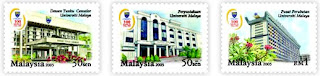
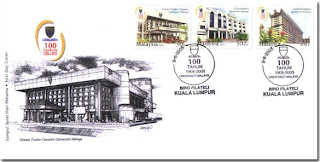
University Malaya StampsDewan Tunku Canselor Universiti Malaya

Dewan Tunku Canselor (DTC), the name given to commemorate the building which was to be the landmark of University Malaya. The hall was officially opened on 25th June 1966 by its namesake, the first Prime Minister of Malaysia, Tunku Abdul Rahman Putra Al-Haj who was also the university's chancellor.

It all started here where students took their pledge upon first stepping foot into UM, where examinations are held and finally where they become graduates upon convocation. This is where all dignified ambitions were born.

DTC first held the convocation ceremony for the year 1965/66 session with 587 graduates receiving their first degree, masters and doctorate while 115 others received Diploma in Education.

University Malaya Miniature SheetUniversity Malaya Library

The University Malaya Library (UML) consists of a main library, which provides library facilities for the whole campus. In addition, there is a network of branch and specialized libraries to meet the specific and particular needs of some faculties. To accomplish its mission of providing excellent collections to support learning, teaching and research activities of the university, the library has, through more than 40 years of existence, built up a substantial collection of monographs, periodicals, manuscripts, audio-visual materials and compact discs. To date, the collection consists of 1.3 volumes of monographs, bound journal and thesis.

Unprinted books and journals are kept in the form of microfilm. These are added with electronic source in CD-ROM and online database. The Microfiche Output Computer Catalogue enables any report to be seen clearly. The computer system is used to obtain and control serial items, member registration, library facilities, index and summary.

Being a component of the national knowledge network, UML has throughout the years adopted a policy of actively acquiring Malaysian materials. One of the library's greatest strengths lies in its University Malaya First Day Covercollection of Malaysian in all subjects.
University Malaya Medical Center

The University Malaya Medical Center is a statutory body of the Ministry of Education. Its main objectives are to provide healthcare services of international standing and repute and also to provide facilities for medical education, training, research internship and consultancy. In University Malaya First Day Cover1961, the Board of Education, University Malaya proposed for a medical institution to be established so as to cater to the shortage of medical doctors in Malaya at the time.

In relation to this, the Faculty of Medicine was established to train medical doctors. The preliminary program was initiated in May 1964. On 2nd August 1965, The Honorable Deputy Prime Minister, the late Tun Haji Abdul Razak bin Hussein officiated the opening ceremony of the Faculty of Medicine, University Malaya and also laid the foundation stone for the then University Hospital Kuala Lumpur. In December 1966, construction of the Tower Block and the Hospital Podium was completed followed by a block for treatment care center activities, pediatrics ward as well as the maternity ward. University Hospital received its first patient in 1967 and was fully functional since then.
University Malaya Stamps SheetRimba Ilmu (Botanical Gardens)

Rimba Ilmu or The Botanical Gardens was established in 1974 out of the need to study and conserve some of the immense diversity of plant life found in the Malaysian tropical rainforest.

The garden is on a valley site situated behind the Fifth Residential College on the University of Malaya campus. The valley has a small stream which feeds a wetland area before filtering out through the easternmost boundary. While fulfilling its essential 'collection and curatio' function, Rimba Ilmu also works towards promoting awareness of the natural environment through the utilization of its resources and support facilities by the University community and the general public.

Besides a general collection of species from a variety of plant families selected for teaching, special collections are being developed which include medicinal plants, wild orchids, palms, pandan, tropical fruit trees, gingers, aquatic plants, wild citrus relatives rare and endangered plants in need of conservation.

University Malaya Stamp BookletUniversity Malaya Museum of Asian Art

The museum of Asian Art which was officially opened in 1980, is housed in a three-storey building situated between the Faculty of Law and the Faculty of Economics and Administration.

The Museum contains more than two thousand pieces of ceramics from Thailand, Cambodia, Vietnam, China, Japan, and India. It is already well-known for having the largest collection of 'kendi' water vessels in the world. Stone carvings and Islamic art collections (from Asian Countries), weaved materials and paintings by local artist, copper items, weapons and kites are also on display.


University Malaya Presentation PackTechnical Details

Date of Issue : 9-Jun-2005

Stamp Value : 30 Sen; 50 Sen; RM 1.00

Stamp Size : 40 mm x 30 mm

Miniature Sheet Value : RM 2.00

Miniature Sheet Size : 70mm x 100mm

Stamp Size in Miniature Sheet : 40mm x 30mm

Perforation : 14

Sheet Content : 20 Stamps

University Malaya FolderPaper : SPM Watermarked, Phosphor Coated

Printing Process : Lithography

Printer : Percetakan Keselamatan Nasional Sdn. Bhd.

Stamp Designer : Hazel Design

First Day Cover Value : 30 Sen

Presentation Pack Value : RM 3.50

Stamp Booklet Value : RM 3.00

Folder Value : RM 5.00


POS Malaysia 9 Jun 2005, Thursday Press Release

STAMPS TO COMMEMORATE THE 100th ANNIVERSARY OF UNIVERSITI MALAYA

Pos Malaysia Berhad (PMB) today launched new commemorative stamps and First Day Cover to celebrate the 100th anniversary of Universiti Malaya.

The stamps and First Day Cover were officially launched by Yang Berbahagia Dato’ Professor Dr. Hashim Yaacob, Vice Chancellor of Universiti Malaya at Dewan Tunku Canselor, Universiti Malaya at 10.00am.

The stamps feature a collection of significant buildings in Universiti Malaya famous for their role in academic endorsement, namely, Dewan Tunku Canselor Universiti Malaya, Universiti Malaya Library, Universiti Malaya Medical Centre, Rimba Ilmu (Botanical Gardens) and Universiti Malaya Museum of Asian Art.

“Universiti Malaya was the first university in Malaysia. Pos Malaysia Berhad is proud to acknowledge this institution which has and continues to help to lay the foundations of the nation by producing generations of skilled and educated citizens,” said Dato’ Ikmal Hijaz Hashim, Managing Director/Chief Executive Officer of Pos Malaysia Berhad.

“With profound appreciation to Universiti Malaya for upholding the importance of education for personal and national development, we hope that this sense of achievement will also be felt by the public through the issuance of these stamps and First Day Cover,” he added.

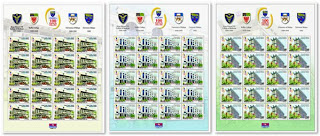
The stamps, 40mm x 30mm in size, are printed in sheets of 20 on “SPM watermarked, phosphor coated paper” and are available in three denominations:
  • 30 sen – Dewan Tunku Canselor Universiti Malaya
    Undoubtedly the most renowned landmark of Universiti Malaya, this hall was named after the first Prime Minister of Malaysia, Tunku Abdul Rahman Putra Al-Haj who officially opened the hall on 25th June 1966 and who was also the university’s Chancellor. Each year this hall has unfailingly greeted young blood, tests their knowledge in examination and proudly congratulates the successful ones in their convocation.

  • 50 sen – Universiti Malaya Library
    Being a component of the national knowledge network for more than 40 years, the Universiti Malaya Library’s vast collection of reading materials focuses not only on academic purposes but also to support materials in all subjects that are related to Malaysia.

  • RM1 – Universiti Malaya Medical Centre
    As a statutory body of the Ministry of Education, this centre provides healthcare services to the community as well as facilities for medical education, training, research internship and consultancy.
Also available is Miniature Sheet, 70mm x 100mm in size, at RM2 which features:
  • Rimba Ilmu (Botanical Gardens)
    Established in 1974, this scientifically oriented garden was built from a 40-hectare of hilly areas of abandoned rubber estate for the need to study and conserve some of the immense diversity of plant life found in tropical forest. Since then it has worked towards creating an environmental conscious society.

  • Universiti Malaya Museum of Asian Art
    Officially opened in 1980, this museum is well-known for having the largest collection of “kendi” water vessels in the world. It also showcases more than 2 thousand pieces of ceramics from various Asian countries.
    First Day Covers at 30 sen each, Presentation Pack at RM3.50 each and Stamp Booklet at RM3 each which contains 10 sheets of 30 sen stamps can be purchased at all Post Offices nationwide. Folder at RM5 each is only available at selected Post Offices.

Alltop, all the top stories
BlogMalaysia.com
All Malaysian Bloggers Project