Wednesday, August 18, 2004

Traditional Transportation Stamp

Traditional Transportation StampsIn the days before automobiles, there were various modes of transportation that people in Malaysia used, in accordance to the prevalent needs and cultures. People from different races and cultures brought and introduced different Traditional Transportation Miniature Sheetkinds of transportation, but all with the same objective of getting from one place to another.

Trishaw

This trishaw originated from Parit Jawa, Muar, Johor. It is painted in green, red, black and yellow, the favorite colors of the era. The hood, made of canvas, can easily be opened or closed when necessary. The seat is made from coconut husk and is complete with a backrest. The trishaw can carry two adult passengers and one or two children.

Rickshaw

The two-wheeled rickshaw was normally used by the rich Babas and Nyonyas in Malacca. It needed a strong man to pull the rickshaw around town, usually with only one passenger, for a leisure ride and to go shopping.

Traditional Transportation First Day CoverBullock Cart

The bullock cart was used as a means of transportation since the 1400's, and it is believed to have been introduced by the Indian community in Malacca. Other than for carrying passengers, it was also used to carry goods. A pair of healthy bulls were usually hitched to pull the cart.

Traditional Transportation First Day CoverPadi Horse

The padi horse is synonymous with the Bajau community in Kota Belud, Sabah. it also serves as a family's status. A famous and influential family would usually own many horses. The padi horse is used as a mode of transport to the padi fields or towns, as well as for the village head to patrol the village. it is also ridden during important social functions or celebrations like weddings and the annual Tamu Besar event.


Traditional Transportation Presentation Pack


Traditional Transportation Stamp SheetTechnical Details

Date of Issue : 18-Aug-2004

Stamp Value : 30 Sen; 50 sen; RM 1.00

Perforation : 14

Sheet Content : 20 Stamps

Stamp Size : 40mm X 30mm

Miniature Sheet Denomination : RM2.00

Miniature Sheet Size : 100mm X 70mm

Stamp Size in Miniature Sheet : 40mm X 50mm

Paper : Watermarked, Phospor Coated

Traditional Transportation FolderPrinting Process : Lithography

Printer : Percetakan Keselamatan Nasional Sdn. Bhd.

Stamp Designer : Reign Associates

First Day Cover Value : 30 sen

Presentation Pack Value : RM 3.50

Folder Value : RM 5.00

Saturday, July 24, 2004

Major Ports of Malaysia Stamp

Ports Of Malaysia StampsMalaysia's location at the southern tip of mainland Asia puts it right in the middle of the sea route between the East and the West. That makes it a strategic port of call for ships plying the trade route. To fulfill the ever expanding merchant marine requirements, Malaysia has developed a number of modern and well-equipped ports along its coast.

Bintulu Port

Bintulu Port Authority was established on 15th August 1981 under the Bintulu Port Authority Act 1981. It was given the responsibilities for the development, administration, marketing and supply of a complete and efficient port, with the vision to establish Bintulu Port into the biggest and most efficient transportation and distribution center within the BIMP EAGA network. Bintulu Port started its operation on 1st January 1983. The Bintulu Port Authority is a Federal Statutory Body Ports Of Malaysia Miniature Sheetunder the Ministry of Transportation of Malaysia.

Northport

Northport (Malaysia) Bhd operates the largest multi-purpose port facility in Malaysia providing a comprehensive range of port services to meet the individual needs of its customers. Its real time smart information system is designed to guarantee operational and cost efficiency, offering faster vessel turnaround time. Apart from offering feeder services to neighbouring countries, Northport has also increased its connectivity to worldwide ports including China, Asia, United States, the Mediterranean and Europe, making it one of the most important hub ports in the Asian region. Northport, the first mainline port of call eastbound on the Europe-Asia leg and last port of call westbound on the Asia-Europe leg, handled 5,527 container vessels, including the world's largest container vessel afloat, in 2003.

Ports Of Malaysia First Day CoverJohor Port

Johor Port, a major international gateway of Malaysia located at Pasir Gudang on the southern tip of Peninsular Malaysia. It is a modern port that is professionally managed and comprehensively equipped to efficiently handle all manner of cargoes and vessels of today's world maritime trade. The Port is linked to all parts of the nation by a comprehensive system of expressways and also by a rail network linked to the national grid which makes for easy access to other parts of the nation. The Port is located in a Free Zone which gives it a distinct business advantage.

Ports Of Malaysia First Day CoverKuantan Port

The establishment of Kuantan Port was initiated by the late Tun Abdul Razak, the second Prime Minister of Malaysia. It was conceived to be the catalyst for the development of the East Coast of the Peninsular. The port started operating in 1980 with four docks and with a capacity to handle 3.2 million tons of cargo a year. It reached full operational status on 1st January 1984. The port continued its development process, and in 2004, with 15 docks, it has the capability of up to 15.1 million tons of cargo annually.

Kota Kinabalu Port

Kota Kinabalu Port has 12 berths, each of which can accommodate vessels of 16,000 displacement tonnes. The port has three warehouses and five open storage areas available for general cargo and containers. It is equipped with modern handling equipment. "Stevedoring" and round the clock security services are provided.

Ports Of Malaysia Presentation PackPenang Port

Penang Port is located along the North-West of Peninsular Malaysia and is one of the leading ports in Malaysia. Serving one of the busiest trade routes in the region, Penang Port links Malaysia - the world's 13th largest exporter nation - to more than 200 ports worldwide through a network of shipping services.

Its strategic location makes it the choice of vessels sailing east bound or westbound. Overlooking the major shipping lanes in the Straits of Malacca, the Port is rapidly emerging as the gateway to the expanding trade opportunities under the Indonesia-Malaysia-Thailand Growth Triangle and the dynamic Asia-Pacific region.


Ports Of Malaysia Stamp SheetTechnical Details

Date of Issue : 24-Jul-2004

Stamp Value : 30 Sen (2 designs); 50 Sen (2 Designs); RM 1.00

Stamp Size : 40mm X 30mm

Perforation : 14

Sheet Content : 20 Stamps

Miniature Sheet Denomination : RM2.00

Miniature Sheet Size : 100mm X 70mm

Stamp Size in Miniature Sheet : 40mm X 30mm

Paper : Watermarked, Phosphor Coated

Printing Process : Lithography

Printer : Percetakan Keselamatan Nasional Sdn. Bhd.

Designer : Reign Associates

Stamp Designer : Reign Associates

First Day Cover Value : 30 Sen

Presentation Pack Value : RM 4.00

Thursday, July 1, 2004

Multimedia Super Corridor Stamp

Multimedia Super Corridor StampMSC Malaysia is one of the world's premier locations for information and communication technology (ICT). It host world-class companies, innovative research and development entities and new start-ups specializing in ICT products, solutions and services.

Multimedia Super Corridor Miniature SheetMalaysia attracts leading ICT companies of the world to locate their industries in the MSC and undertake research, develop new products and technologies and export from this base. MSC Malaysia is also an ideal growth environment for Malaysian ICT companies to transform themselves into world-class enterprises. Furthermore, the MSC welcomes countries to use its highly advanced infrastructural facilities as a global testbed for ICT applications and a hub for their global and regional operations in Asia.

Located at the heart of Asia's fastest growing markets, MSC Malaysia has become the choice location for global innovators and investors. Its unique competitive advantages stem from its dynamic and vibrant multilingual workforce; lower costs and ease of doing business, world-class infrastructure with guaranteed service levels; political and institutional stability; excellent living standards; and a proven track record in developing outstanding ICT products and services for regional and global markets.

Major MSC Initiatives

MSC Flagship Applications for the Development of the Nation

Multimedia Super Corridor First Day CoverMyKad

e-Government

Smart School

Telehealth

e-Business

Multimedia Super Corridor First Day CoverTechnopreneur Development

Research and Development

Shared Services & Outsourcing

MSC Malaysia is rapidly gaining recognition as "Asia's Shared Services and Outsourcing Haven", hosting the global and regional operations of many large multinationals.

Multimedia Super Corridor Presentation PackCreative Multimedia

MSC Malaysia has become a utopia for creative multimedia companies to meet the increased global demand for creative content for film, television, animation and computer generated images.

The Multimedia Development Corporation (MDC)

Mandated to oversee the development of the MSC is the Multimedia Development Corporation. Based in Cyberjaya, MDC facilitates applications by foreign and local companies to re-locate to the MSC, globally markets the MSC, shapes MSC-specfic laws, policies and practices and standardizes the MSC's infrastructural and urban development.


Multimedia Super Corridor StampSheetTechnical Details

Date of Issue ; 1-Jul-2004

Stamp Value : 30 Sen; 50 Sen; RM 1.00

Sheet Content : 20Stamps

Perforation : 14

Stamp Size : 40mm X 30mm

Miniature Sheet Denomination : RM2.00

Miniature Sheet Size : 70mm X 100mm

Stamp Size in Miniature Sheet : 30mm X 40mm

Paper : Watermarked, Phosphor Coated

Printing Process : Lithography

Printer : Secura Security Printing Sdn. Bhd.

Printer for Mini Sheet : Percetakan Keselamatan Nasional Sdn. Bhd.

Designer : Reign Associates Sdn. Bhd.

First Day Cover Value : 30 Sen

Presentation Pack Value : RM 3.50

Folder Value : RM 5.00


Monday, June 14, 2004

Wildlife In The Malaysian Forest Stamp

Wildlife StampsThe Malaysian rainforest is home to a great variety of wildlife. More than 200 known species of mammals roam the forest, from the mighty elephants to the littlest mousedeers, and the ferocious tigers to the shy tapirs. Apart from these, there are also various other animals that are equally interesting. Of birds themselves, more than 600 species have been identified, including the large Hornbill to the tiny Hummingbird. In addition to that, there are reptiles and fish, and thousands of insects. Indeed, the wildlife in Malaysia represents a rich heritage for us to cherish and to protect.

Buceros Rhinoceros (Enggang Badak)

The majestic Buceros Rhinoceros (Enggang Badak) inhabit the tops of the tallest trees, and usually live in pairs. Its beak and casque are distinctly colored orange and red. The birds primarily eat fruit and their favorite is figs. When the hornbills spread its wings and fly overhead, it produces loud flapping sounds. The population of the Rhinoceros hornbill is in decline, except in a few reserves.

Wildlife Miniature SheetTapirus Indicus (Cipan)

The Tapirus Indicus are very shy animals, and usually lives near permanent water sources in the forest. It is easily recognized by its black head and forelegs, white middle, and black hind legs. It has a very short tail and its nose is elongated into a short trunk. The nocturnal Cipans usually lead solitary lives, except when it is the mating season. The young remains with its mother for six to eight months. They mostly eat leaves and other undergrowth plants.

Muntiacus Muntjak (Kijang)

The Muntiacus Muntjak (Kijang) has short, soft hairs ranging from deep brown to gray-brown with creamy markings. The males have short antlers - that are shed annually - and tusk-like upper canine teeth. They eat sprouts, fruits, seeds, birds' eggs, small animals and carrion. The Kijang are also called barking deer for their warning call that sounds like a dog's bark. The solitary males are extremely territorial, and will fight for females or territory using antlers or even the more dangerous canines.
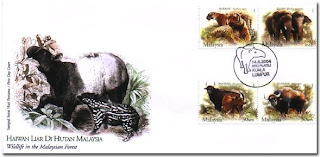
Wildlife First Day CoverTragulus Napu (Napuh)

Napuh (Tragulus Napu) is orangey-brown in colour, with lightly grizzled black hindquarters. The head is triangular with a series of white markings on the neck. Instead of horns or antlers, the males have elongated upper canines or tusks which look like fangs. The legs are extremely thin and delicate, and they move through thick bush using tiny, tunnel-like trails. The Napuh are nocturnal, and hence rarely seen. Their diet consists of buds, leaves and fruit.

Wildlife First Day CoverBos Javanicus (Banteng)

The Bos Javanicus (Banteng) have white "stocking" on their lower legs, a white rump, a white muzzle, and white spots above the eyes. The males can be distinguished from the females by their horns. Females have short and tightly curved horns, while the males have long horns that are curved upwards. The banteng is usually active during day or night, but in areas with human encroachment, they have become nocturnal. These wild cattle are very shy and are hard to approach. They move in herds of 2-40 animals with a single mature male, and eat mostly grass, leaves and shoots.

Bos Gaurus (Seladang)

The Bos Gaurus (Seladang) is muscular and has striking light eyes. Adult males are shiny black with cream-colored leggings and rump patch, while young males and females are medium to dark brown with the same markings. The Seladang has a large hump at the shoulders and sturdy legs. Males can weigh up to 2,100 pounds. They move in herds with 6-20 animals, comprising few old bulls, juveniles, and adult cows with calves. The Seladang usually feeds in the afternoon on dry grasses, young shoots, and the fruits of bushes and trees.

Panthera Tigris (Harimau)

The Panthera Tigris (Harimau) is the largest among cat species. It is perhaps the most majestic animal and also very endangered, with not more than a few hundred left in the Peninsular. Tiger coats range from rusty orange to yellow orange in color, with its underbody and face being creamy to white, flanked by large vertical stripes. Tigers are solitary hunters and very excellent swimmers. They often chase their prey down into the water. Tigers eat almost anything that they can catch like rabbits, wild boar, deer, buffalo, young elephants, rhinos, waterfowl, and elk, that makes up the majority of their diet. Tigers hide and wait for their prey, and pounce when they are close, killing with a lethal bite to the back of the throat.

Wildlife Presentation PackElephas Maximus (Gajah)

The Elephas Maximus (Gajah) or Asian elephants are smaller than their African cousins, and have only a single "finger" at the tip of the trunk (instead of two). The skin color varies from grey to brown and the large males can have tusks up to one metre long. Asian female elephants do not bear tusks. The elephants roam the monsoon forest and eat a wide variety of plants including bananas, palms, barks and leaves from a wide variety of trees and shrubs. Asian elephants are quite sociable, moving in herds of about 20 or more. The elephants are matriarchal, led by the oldest female in search of food and water. Elephants are also tamed to carry out logging work.


Wildlife Stamps SheetTechnical Details

Date of Issue : 14-Jun-2004

Stamp Value : 30 Sen (2 Designs); RM1.00(2 Designs)

Perforation : 14

Sheet Content : 20 Stamps

Stamp Size : 40mm X 30mm

Wildlife FolderMiniature Sheet Denomination : RM2.00

Miniature Sheet Size : 100mm X 70mm

Stamp Size in Miniature Sheet : 30mm X 40mm

Paper : Watermarked, Phospor Coated

Printing Process : Lithography

Printer : Percetakan Keselamatan Nasional Sdn. Bhd. (M/S)

Stamp Designer : Reign Associates

First Day Cover Value : 30 Sen

Presentation Pack Value : RM 4.00

Folder Value : RM 5.00

Monday, May 31, 2004

30th Anniversary Malaysia-China Diplomatic Relationship Stamp

30th Anniversary Malaysia-China Diplomatic StampsThe 30 sen stamp features illustrations of two ships from Malaya and China. These ships symbolise the start of the relationship between Malacca and China 600 years ago. Diplomatic relationship were built based on the official visit of the famed Admiral Cheng Ho from China to Malacca in 1405. This sparked the growth of trade relations between the two countries and Malaya became the port of choice for many tradesmen from China. The ship gracing the Malaysian stamp is called 'Lanchara' and it was not only a trade ship but could turn into a battleship.

30th Anniversary Malaysia-China Diplomatic Miniature SheetTwo hands locked in a firm handshake is the perfect symbol of the close relationship between Malaysia and China. As partners in trade, tourism and technology, Malaysia and China have helped each other develop these sectors extensively. The Chinese and Malaysian currencies form the backdrop of the Malaysian stamp, alluding to the importance of trade between the two nations. A unique feature of this stamp is the inclusion of both the Malaysian and Chinese flags, a feature that is rarely used in stamps. Both the stamps are adorned with a drawing of trade ship, symbolising the start of relations between Malaysia and China.

The miniture sheet is very unique because it features two mosques that can be found in Malaysia and China. The Niujie Mosque is the oldest and biggest mosque in Beijing, China and it has been in existence for over 1000 years. Its beautiful architecture is a striking combination of Chinese design and Islamic features and was masterminded by an Arab scholar during the Liao Dynasty.

Tha Kampung Hulu Mosque from Malaysia can be found in the state of Malacca. It was built in 1728 during the Dutch occupation and was built to replace the first mosque of the city. Its architecture appears typically Chinese, inspired by the pagodas of China.


30th Anniversary Malaysia-China Diplomatic First Day Cover

30th Anniversary Malaysia-China Diplomatic First Day Cover


Technical Details

30th Anniversary Malaysia-China Diplomatic Presentation PackDate of Issue : 31-May-2004

Stamp Value : 30 Sen (2 Designs); RM1.00 (2 Designs)

Perforation : 14

Sheet Content : 20 Stamps

Stamp Size : 30mm X 40mm

Miniature Sheet Denomination : RM2.00

Miniature Sheet Size : 100mm X 70mm

Stamp Size in Miniature Sheet : 60mm X 40mm

Paper : Watermarked, Phospor Coated

30th Anniversary Malaysia-China Diplomatic FolderPrinting Process : Lithography

Stamp Designer : Hazel Design

Printer : Percetakan Keselamatan Nasional Sdn. Bhd.

First Day Cover Value : 30 Sen

Presentation Pack Value : RM 4.20

Folder Value : RM 5.00


Saturday, May 22, 2004

National Service Programme Stamp

National Service StampInitiated by the government, National Service Programme (NSP) was conceived out of a desire to inculcate the spirit of patriotism in the hearts and minds of Malaysian youths of eighteen (18) years of age. A three-month stint-based program, NSP is also to tap and instill the 'Malaysia Boleh' culture in the youths regardless of their racial and religious backgrounds, besides shaping them into disciplined, independent and resilient citizens capable of advancing the nation ahead. The youth of the country constitutes 60% of the population hence their talents and energies are integral elements of national development and progress. NSP is for those born in 1986. Ultimately, the program is envisioned to produce true patriots who would inherit the responsibility of integrating the various races together and nation-building, which are the goals of Vision 2020.

National Service Miniature SheetLaunched by the Prime Minister on 22 February 2004, National Service Programme is :

  • based on the principles of the 'Rukun Negara'.

  • not a military-style conscription and has its own uniform, anthem and logo.

  • for both gender.

  • focused on a multi-disciplinary co-curiculum.


The objectives are to :
  • Develop a young generation who are patriotic and with love for their country.

  • Enhance unity among the multi-racial communities in the country.

  • Instill a spirit of caring and volunteerism among society.

  • Produce an active, intelligent and confident generation.

  • Develop positive characteristics among the younger generation through good values.


The NSP programmed will be conducted over a three-month period during which the participants will go through four modules as follows -

Physical Module
  • Basic marching.

  • Hand-to-hand combat.

  • Abseiling / flying fox and low roping exercises.

  • Rafting / Canoeing.

  • Creative sports.

  • Survival skills.

  • First aid lessons.


National Service First Day CoverNationality Module
  • Nation's history, sovereignty and dignity.

  • Malaysia and international affairs.

  • Defence and national security.

  • Citizens' responsibility to the nation.


National Service First Day CoverCharacter-Building Module
  • Instillation of good values.

  • Self-confidence, leadership, self-evaluation.


Community Service Module
  • Building and restoring public amenities.

  • Environmental restoration and protection.

  • "Gotong-royong" and public service acts.

  • Charitable activities.

National Service 30c Stamp SheetNational Service 50c Stamp Sheet


National Service RM1 Stamp SheetTechnical Details

Date of Issue : 22-May-2004

Stamp Value : 30 Sen; 50 Sen; RM1.00

Stamp Size : 30mm X 40mm

Perforation : 14

Sheet Content : 20 Stamps

Miniature Sheet Value : RM2.00

Miniature Sheet Size : 70mm X 100mm

Stamp Size in Miniature Sheet : 30mm X 40mm

Paper : Watermarked, Phospor Coated

Printing Process : Lithography

Printer : Secura Security Printing Sdn. Bhd. (Stamps)

Printer : Percetakan Keselamatan Nasional Sdn. Bhd. (M/S)

Designer : Creative & Communications House Sdn. Bhd.

First Day Cover Value : 30 Sen


Alltop, all the top stories
BlogMalaysia.com
All Malaysian Bloggers Project